- /
- India Tour Packages
- / 17 Days Assam, Meghalaya & Nagaland Hornbill Festival Tour
17 Days Assam, Meghalaya & Nagaland Hornbill Festival Tour
16 Nights / 17 Days
Places Covered: Delhi - Guwahati - Umananda - Mawphlang - Shillong - Mawlynnong - Dawki - Cherrapunjee - Guwahati - Dimapur - Khonoma Village - Kohima - Mokokchung - Ungma Village - Sivasagar - Mon - Dibrugarh - Delhi
Overview
India's far northeast has a character that cannot be understood through monuments alone. Here, rivers determine the rhythm of cities, forests are protected through community traditions, roots are trained into bridges, and villages preserve identities that differ considerably from one valley to the next. The 17 Days Assam, Meghalaya & Nagaland Hornbill Festival Tour has been designed around these contrasts, linking the Brahmaputra plains of Assam with Meghalaya's Khasi Hills and the culturally diverse Naga highlands.
The journey begins in Guwahati before moving through silk-producing settlements, religious centres and archaeological remains of Assam. Meghalaya follows with Shillong, Mawphlang, Mawlynnong, Dawki and Cherrapunjee. Clear river water, densely wooded hills, living root bridges and long-established Khasi customs give this section a strong connection with both landscape and local life. A demanding walk to Nongriat's Double Decker Living Root Bridge brings travellers deeper into terrain that cannot be appreciated from the roadside alone.
Nagaland adds an entirely different dimension to the route. Khonoma, Kohima, Kisama, Mokokchung and Mon introduce travellers to communities belonging to different Naga groups, while the Hornbill Festival brings their music, ceremonial dress, crafts, food and performing traditions together at one venue. The later journey through Ao and Konyak areas, historic Sivasagar and the tea country around Dibrugarh makes this much more than a festival-only itinerary. It is a comprehensive Northeast India cultural tour created for travellers who want to spend meaningful time across Assam, Meghalaya and Nagaland rather than simply passing through their principal cities.
Highlights
- Travel through Assam, Meghalaya and Nagaland on one 17-day Northeast India itinerary.
- Visit the sacred Kamakhya Temple on Guwahati's Nilachal Hill.
- See Assam's traditional silk-weaving community at Sualkuchi.
- Visit Hajo and the archaeological remains at Madan Kamdev.
- Cross into Meghalaya for Shillong, Umiam Lake and Mawphlang Sacred Forest.
- Spend time in Mawlynnong and see the living root bridge near Riwai.
- Reach Dawki and the Umngot River close to the India–Bangladesh frontier.
- Stay in Cherrapunjee and visit its famous waterfall viewpoints.
- Trek through Nongriat to the remarkable Double Decker Living Root Bridge.
- Enter Nagaland through Dimapur and continue towards the Angami region.
- Walk through Khonoma village before reaching Kohima.
- Attend the Hornbill Festival at Kisama Heritage Village during the Nagaland section.
- Continue later towards Ao Naga settlements around Mokokchung and Konyak country near Mon.
- Visit Longwa, a remote village situated along the India–Myanmar boundary.
- Complete the Northeast circuit at Dibrugarh in Assam's renowned tea-growing region.
Itinerary
Your Northeast India journey begins with a flight from Delhi to Guwahati, the principal gateway to Assam and an important starting point for travel into Meghalaya and Nagaland. The transition becomes noticeable even before landing, as the densely settled northern plains give way to the broad Brahmaputra Valley and greener terrain. After reaching Guwahati Airport, you will be welcomed by our representative and assisted to your private vehicle. Drive to the hotel, complete the check-in formalities and settle into your room. No demanding sightseeing has been planned for the arrival day so that the tour starts at a comfortable pace.
Guwahati occupies a strategic position beside the Brahmaputra, one of Asia's great river systems, and has long served as a commercial and cultural meeting point for this part of India. Modern neighbourhoods now spread widely around the city, yet old temples, river ghats and Assamese traditions remain an important part of its identity. Your first evening provides time to adjust to the surroundings before travelling into the smaller towns and hill regions included later in the itinerary. Those arriving after a longer international journey can use these hours simply to rest at the hotel.
The coming days will take you from Assam's river valley into the Khasi Hills of Meghalaya and eventually across the tribal regions of Nagaland. This first overnight halt is therefore deliberately uncomplicated, allowing the longer sightseeing programme to begin the following morning. Depending upon the flight schedule, you may spend some free time around the hotel or relax after the transfer. Dinner will be served according to the booked meal arrangement. Overnight stay in Guwahati
Begin the morning at Kamakhya Temple, positioned high on Nilachal Hill and regarded as one of Assam's foremost centres of Shakti worship. Rather than functioning simply as a sightseeing monument, Kamakhya remains an active place of pilgrimage where rituals and daily worship form the central part of the visit. Its hilltop setting also places you above the busy streets of Guwahati and provides an early introduction to the religious traditions of the Brahmaputra Valley. Time will be available around the temple precinct before leaving the city for the rural areas lying beyond Guwahati.
The next halt is Sualkuchi, where weaving remains closely connected with household life and the local economy. Looms can be found throughout the settlement, and generations of artisans have worked with Assamese silks to produce sarees, traditional garments and finely patterned textiles. Of particular interest is Muga silk, recognised for its natural golden appearance and strong association with Assam. Continue afterwards towards Hajo, where sacred places belonging to different faith traditions exist within the same town. This combination of craft and religion provides a broader understanding of Assam than a city-only sightseeing programme could offer.
Later in the day, travel to Madan Kamdev, where stone fragments and sculptural remains are spread across a wooded archaeological setting. Unlike the busy atmosphere encountered at Kamakhya, this location presents a quieter encounter with Assam's historic temple art. Carved figures, architectural pieces and surviving temple structures provide glimpses into artistic traditions that flourished in the region centuries ago. After spending time around the site, return by road to Guwahati. Arrive at the hotel in the evening, followed by dinner and overnight stay in Guwahati.
After breakfast, make your way towards the Brahmaputra for a visit to Umananda Island, subject to the operation of the local ferry service. The small river island is associated with a Shiva temple and offers a very different setting from the large religious complex visited on the previous day. Travelling across the river also provides a close view of the Brahmaputra itself, whose immense width has shaped settlement, agriculture and transport throughout Assam. Once back on the mainland, leave Guwahati behind and start the road journey towards Meghalaya.
The highway gradually climbs from Assam's lower elevations into the Khasi Hills, where the vegetation, road scenery and climate begin to change. Pause at Umiam Lake, a vast body of water surrounded by undulating green hills on the approach to Shillong. Rather than heading directly into the state capital, continue towards Mawphlang, an area deeply associated with Khasi cultural traditions. The Sacred Forest here has remained protected through community beliefs that place restrictions on removing plants, stones and other natural material from within its boundaries.
Walking around Mawphlang introduces a relationship between nature and customary practice that is central to understanding rural Meghalaya. Local guidance helps place the forest in its cultural context instead of treating it merely as a scenic woodland. Afterwards, drive onward to Shillong, one of Northeast India's best-known hill cities and the capital of Meghalaya. On arrival, check in at the hotel and spend the remainder of the evening at leisure after a varied day on the road. Dinner and overnight stay in Shillong.
Leave Shillong after an early breakfast and travel through the East Khasi Hills towards Mawlynnong. The village is known for its carefully maintained surroundings, but the more interesting aspect of a visit is seeing how community participation influences the appearance and management of the settlement. Walk through the village lanes before proceeding towards nearby Riwai to see a Living Root Bridge. These bridges are not assembled from conventional construction materials; they develop gradually as the aerial roots of rubber trees are directed across streams until they become strong enough to form a usable crossing.
Continue towards Dawki, located close to India's international boundary with Bangladesh. The principal natural attraction here is the Umngot River, whose water can become strikingly transparent when seasonal and weather conditions are favourable. A traditional boat ride may be taken when river conditions permit, allowing you to see the rocky riverbed and forested banks from water level. The surrounding hills descend towards the plains across the border, creating a landscape very different from the higher Khasi plateau. Time will be available around the river before beginning the onward journey.
From Dawki, turn westward towards Cherrapunjee, locally known as Sohra, travelling again through Meghalaya's deeply cut hill terrain. Waterfalls, limestone formations and steep green valleys have made this area one of the most recognisable landscapes in Northeast India. The day's programme deliberately combines village life, a living-root structure and the borderland river environment before reaching the night's destination. Check into the hotel on arrival in Cherrapunjee and rest after the lengthy road journey. Dinner and overnight stay in Cherrapunjee.
Today is reserved for Cherrapunjee and its surrounding landscape, avoiding another long intercity drive. Start with Nohkalikai Falls, where water plunges from the edge of the plateau into a deep valley below. The appearance of the waterfall varies significantly with rainfall, which is an important feature of sightseeing in Meghalaya. The viewpoint gives a clear sense of the sharp elevation changes that define this part of the Khasi Hills. Adequate time will be kept for photography and for observing the valley rather than treating the location as a brief roadside stop.
Continue to viewpoints associated with the Nohsngithiang Falls, widely known as the Seven Sisters Falls. Multiple streams descend over a broad cliff face, creating their most dramatic appearance during periods of stronger water flow. In drier months the volume can be considerably lower, but the surrounding escarpment and open views remain worthwhile parts of the Cherrapunjee landscape. The day is intentionally kept at a slower pace because the following morning includes the most physically demanding activity of the Meghalaya section.
The remaining time can be spent seeing more of Sohra's hill environment and enjoying a quieter afternoon around Cherrapunjee. This area receives exceptionally heavy seasonal rainfall, and water has shaped much of its terrain through steep valleys, caves, streams and dramatic cliff formations. It also forms part of the homeland of Khasi communities whose settlements are scattered throughout these hills. Return to the hotel after completing the day's visits and prepare suitable footwear and essentials for tomorrow's trek. Dinner and overnight stay in Cherrapunjee.
An early start is required for the journey towards the trail leading to Nongriat village and the Double Decker Living Root Bridge. This is not a casual sightseeing walk; the route involves a substantial number of steps, uneven sections and a considerable climb on the return journey. Travellers should therefore approach the trek according to their personal fitness level and follow the instructions of the accompanying local guide. As the path drops away from the road, settlements and thick subtropical vegetation gradually replace the more accessible viewpoints visited during the previous day.
The reward lies deep within the valley, where living roots have been shaped over generations to create durable crossings above streams. The famous double-level structure at Nongriat demonstrates a form of practical knowledge developed in response to Meghalaya's wet climate, where ordinary wooden bridges would deteriorate relatively quickly. Time around the bridge allows you to appreciate its scale and the environment in which it continues to be used. Depending on local conditions and the available time, nearby natural pools and suspension crossings may also form part of the walking route. The source programme notes that this trek takes approximately four to five hours and involves roughly 4,000 steps, making good physical condition important. New Booking Maria Grazia Zugna
After climbing back to the roadhead, continue with the onward road journey towards Guwahati. Depending upon timing and operational feasibility, additional Meghalaya stops scheduled along the return sector can be covered before descending from the hills into Assam. The change in scenery is pronounced as the road leaves the Khasi plateau and re-enters the broader Brahmaputra Valley. This will be a long and active day, so the evening is kept free once you reach the hotel. Check in, have dinner and stay overnight in Guwahati.
Following breakfast, depart Guwahati and begin the journey towards Dimapur, the principal entry point for the Nagaland section of the tour. This travel day marks an important shift in the itinerary: the waterfalls and Khasi landscapes of Meghalaya now give way to a region known for its Naga communities, village traditions and distinct historical background. The drive covers a substantial distance, so suitable comfort stops will be taken along the way. As you approach Dimapur, the journey begins the transition from Assam's valley environment towards the hills that dominate much of Nagaland.
After reaching Dimapur, visit the remains associated with the Kachari civilisation, one of the city's most significant historical sites. The unusual stone structures found here provide a reminder that Dimapur possessed political importance long before it developed into the busy commercial centre seen today. Rather than beginning Nagaland only with tribal villages, this visit provides useful historical context for the different kingdoms and communities that have shaped the region. Afterwards, time permitting, proceed towards a local market where everyday produce, household goods and regional ingredients reveal another side of contemporary life in the city.
Dimapur differs considerably from the quieter hill settlements that will follow. It functions as a transport and trading hub, making it a practical gateway before travelling towards Kohima and the higher Naga country. After sightseeing, transfer to the hotel and complete the check-in formalities. Use the evening to rest, as tomorrow introduces both the Angami village landscape and Nagaland's state capital. Dinner will be provided according to the selected meal plan, followed by an overnight stay in Dimapur.
Leave Dimapur after breakfast and start climbing towards Kohima, with a visit to Khonoma forming the cultural focus of the day. Khonoma is closely associated with the Angami Naga community and occupies an important place in the history of resistance to British expansion in the Naga Hills. Its terraced surroundings and compact village layout also show how settlement and agriculture have adapted to steep mountain terrain. Rather than treating Khonoma as a quick photographic stop, the visit allows time to walk through parts of the village and gain a clearer sense of its historical and community character.
Khonoma has also become known for locally driven conservation initiatives. Hunting, forest use and community responsibilities have undergone significant changes here, making the village an interesting example of how older practices and modern environmental concerns can interact. Traditional houses, narrow lanes, cultivated slopes and memorial elements contribute to the character of the settlement. Conversations and observations during the visit can provide a more grounded introduction to Angami life before the larger cultural presentation of the Hornbill Festival. The original route also places Khonoma between Dimapur and Kohima, keeping this important village within the natural progression of the journey. New Booking Maria Grazia Zugna
Continue afterwards to Kohima, Nagaland's hill capital and the base for the coming Hornbill Festival programme. Depending on arrival time, spend some time around the local market area, where regional produce, handicrafts and everyday goods offer an immediate glimpse into the city's daily routine. Kohima will remain your base for the next stage, allowing sufficient time for the festival as well as additional cultural visits around the region. Check into the hotel and keep the evening relaxed before the festival programme begins. Dinner and overnight stay in Kohima.
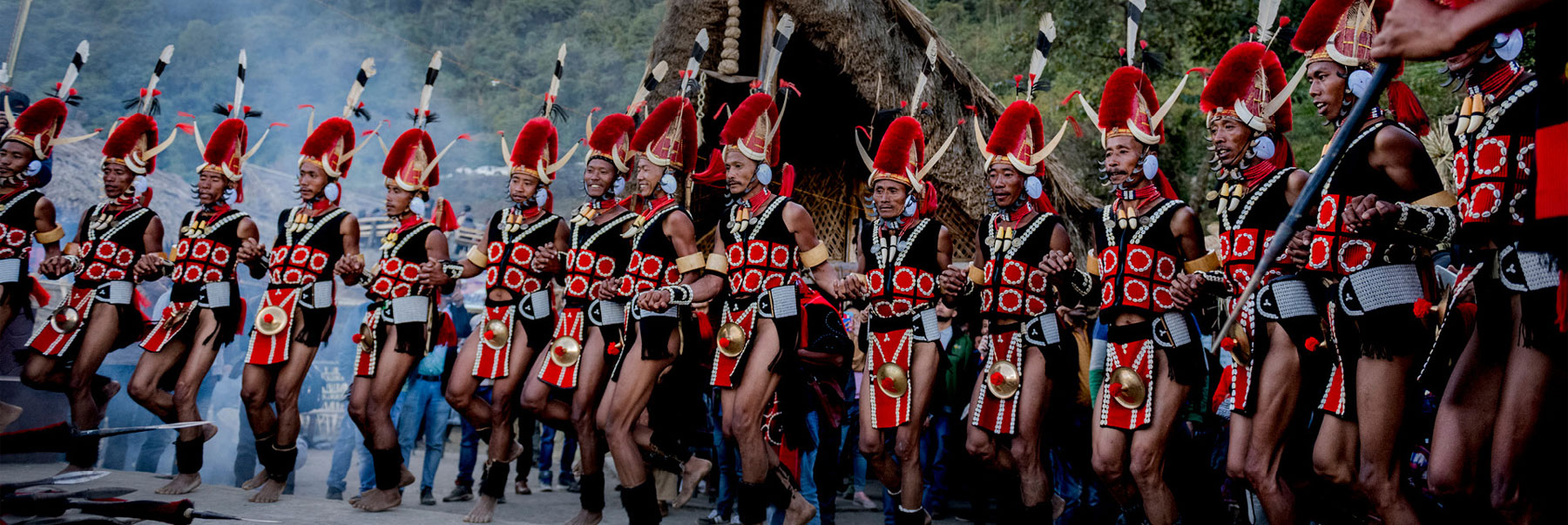
After breakfast, leave the hotel for Kisama Heritage Village, the principal venue of the Hornbill Festival and the centrepiece of this Northeast India journey. The festival brings communities from across Nagaland together in a setting created to present the state's varied cultural traditions. Rather than visiting individual regions separately, travellers have an opportunity here to see representatives of different Naga groups gathered within the same festival grounds. Traditional attire, ceremonial objects, community spaces and cultural demonstrations make Kisama particularly rewarding for visitors interested in the people and traditions of Northeast India.
Spend the greater part of the day following the scheduled Hornbill Festival programme. Performances generally revolve around traditional dance, music, folk customs and demonstrations connected with community life, while craft areas provide a closer look at weaving, woodwork, bamboo products and other locally produced items. The festival is also an excellent setting for photography, as clothing, ornaments and performance traditions vary considerably among participating Naga communities. Instead of rushing through the venue, sufficient time will be available to move between the different areas and observe the programme as it develops during the day.
As evening approaches, return towards Kohima and spend time around the Hornbill Night Carnival, subject to the festival programme and local arrangements. Streets take on a livelier character with food stalls, handicrafts and evening activities attracting residents and visitors alike. This provides a more informal contrast to the organised cultural presentations at Kisama earlier in the day. Afterwards, return to the hotel for dinner and rest. Overnight stay in Kohima. The source itinerary allocates this day to Kisama's festival programme and the evening carnival. New Booking Maria Grazia Zugna
Begin the morning with a drive to Touphema Heritage Village, where the day's programme provides another perspective on Angami Naga culture beyond the festival grounds. The village setting allows travellers to look more closely at traditional architectural forms and cultural practices associated with the region. Nagaland's communities possess their own histories, social customs and artistic traditions, and a visit outside Kohima helps place some of the festival presentations into a broader geographical context. Spend time walking through the heritage area and learning about aspects of village life before returning towards Kohima.
Later, travel again to Kisama Heritage Village for another session at the Hornbill Festival. A second visit is worthwhile because the programme changes through the festival period and a single day cannot adequately cover all its performances and cultural spaces. Use the afternoon to see sections missed previously, watch additional scheduled events and spend more time around the traditional community structures represented within the complex. Visitors interested in crafts can also look more carefully at regional textiles, ornaments and handmade products displayed by participating artisans.
By giving the festival two days rather than reducing it to a short visit, the itinerary allows its cultural importance to remain central to the Nagaland section. There is also greater flexibility to follow performances according to the official programme operating during the travel dates. At the end of the day's activities, return to Kohima and relax at the hotel. Dinner will be arranged according to the booked meal plan. Overnight stay in Kohima. The reference programme similarly combines Touphema with a return visit to the Hornbill Festival on this day. New Booking Maria Grazia Zugna
Check out after breakfast and leave Kohima for Mokokchung, travelling through the mountainous interior of Nagaland. Today's drive shifts the journey away from the Angami cultural region towards an area strongly associated with the Ao Naga community. Roads through Nagaland often require more travel time than their distances might suggest, but the changing hill scenery and small settlements make the journey an important part of the itinerary. Stops will be made where appropriate so that the day is not simply spent travelling from one hotel to another.
On the way, pass through the Wokha region, where villages scattered across the hills provide a glimpse into another part of rural Nagaland. The cultural identity of the communities changes as the journey progresses, reinforcing how diverse Nagaland is despite its relatively compact geography. Village visits, when possible according to local arrangements, provide opportunities to observe settlement patterns, agricultural surroundings and everyday life outside the main towns. Respect for community customs and local guidance will remain important throughout these visits.
Reach Mokokchung, widely regarded as an important cultural centre of the Ao Naga people. Depending upon arrival time and local arrangements, visit a nearby settlement to become acquainted with Ao village traditions and the rural environment surrounding the town. Afterwards, proceed to your accommodation and settle in after the day's drive. The evening is kept free for rest before further village visits the following morning. Dinner and overnight stay in Mokokchung. The source route also places Mokokchung immediately after the three-night Kohima section. New Booking Maria Grazia Zugna
After breakfast, spend the morning around the Ao cultural region with a visit to Ungma, one of the established villages near Mokokchung. The settlement provides an opportunity to move beyond festival presentations and see cultural identity within an inhabited village environment. Traditional elements exist alongside contemporary homes and changing lifestyles, making the visit useful for understanding how Naga communities maintain aspects of their heritage while adapting to modern circumstances. Walk through designated areas with appropriate local assistance and observe the architecture and surrounding agricultural landscape.
Depending upon local permissions, timing and road conditions, another Ao settlement may be included before leaving Nagaland. These village visits are intended to provide context rather than stage-managed demonstrations, so the programme should remain respectful of residents and everyday activities. The Ao people have a strong tradition of community organisation, oral history and cultural practices passed between generations. Spending the morning in this region adds depth to the Nagaland tribal tour before the route returns to Assam.
Continue by road to Sivasagar, historically associated with the Ahom kingdom that ruled large areas of Assam for centuries. The change from Nagaland's hills to Assam's lower terrain becomes increasingly evident during the drive. Sivasagar adds an important historical layer to the itinerary, shifting attention from Naga village traditions towards Assam's royal and architectural past. Reach the town later in the day, check into the hotel and relax after the journey. Dinner and overnight stay in Sivasagar. New Booking Maria Grazia Zugna
Begin the day with sightseeing in Sivasagar, one of Assam's most significant centres for understanding the legacy of the Ahom period. Visit Shiva Dol, a prominent temple complex that continues to function as an active place of worship. Its tall temple tower forms one of the recognisable landmarks of the town and provides a distinct contrast to the village architecture encountered during the previous days in Nagaland. The visit introduces another strand of Northeast India's history before the journey turns once again towards the Naga Hills.
Continue to Rang Ghar, an unusual historic structure associated with the Ahom royal period. Its surviving architecture reflects the political and ceremonial life of a kingdom that played a major role in Assam's history. Time around Sivasagar is intentionally concentrated into the morning so that the itinerary can combine meaningful sightseeing with the onward transfer. After completing the visits, leave Assam and begin travelling towards Mon, one of the most remote destinations included in this 17-day Northeast India tour.
The approach to Mon takes you into an area closely associated with the Konyak Naga community. Compared with Kohima and Dimapur, this section feels considerably more isolated, and the road itself forms part of the transition into northeastern Nagaland. Konyak cultural history, village organisation and distinctive artistic traditions have made the Mon district particularly interesting to travellers seeking a deeper understanding of Nagaland. Arrive later in the day and check into your accommodation. Have dinner and settle in for an overnight stay in Mon. New Booking Maria Grazia Zugna
Today is dedicated to the Konyak region, beginning with an excursion towards Longwa, one of the best-known villages in the Mon district. The settlement occupies a remarkable position along the India–Myanmar boundary, giving it a geographical character unlike any other destination on this itinerary. The journey to Longwa passes through remote hill country where road conditions may be rough and travel can take longer than expected. For this reason, the day's schedule should remain flexible and follow the advice of the local team regarding accessibility and prevailing conditions.
Once in Longwa, spend time learning about the village and the cultural traditions of its Konyak residents. One of its most unusual features is the traditional house of the village chief, commonly known as the Angh, associated with the international boundary running through the settlement. Beyond this geographical curiosity, Longwa is valuable because it provides access to a part of Nagaland where Konyak identity remains strongly visible. Village architecture, woodwork, ornaments and community traditions all contribute to a cultural environment very different from that encountered around Kohima or Mokokchung.
The visit will be conducted with a local guide, ensuring that movement through community areas remains appropriate and culturally respectful. Time permitting, other nearby Konyak settlements may be approached according to local arrangements. Road conditions in this remote district can affect the day's programme, so safety and practical accessibility will take priority over a rigid schedule. Return to Mon after completing the excursion and spend the evening at your accommodation. Dinner and overnight stay in Mon. The reference itinerary likewise notes local-guide requirements and the possibility of programme changes if road access to Longwa becomes unsuitable. New Booking Maria Grazia Zugna
After breakfast, leave Mon and begin the journey back into Assam, travelling towards Dibrugarh. Today's route gradually replaces Nagaland's isolated hill scenery with the broader landscapes of Upper Assam. The transfer is relatively long and road conditions can influence the actual driving time, so comfort stops will be made as required. After several days focused on Naga villages and hill communities, the return to the Brahmaputra Valley creates another noticeable change in both landscape and settlement patterns.
Arrive in Dibrugarh, a major city in Upper Assam and a name closely associated with the state's tea industry. Tea estates spread across this part of the Brahmaputra Valley, and the industry has influenced the region's economy, settlement and history for generations. Dibrugarh also serves as an important commercial centre for eastern Assam, giving it a busier character than the remote settlements visited during the preceding days. After arrival, check into your accommodation and take some time to rest following the road journey.
Later, depending upon arrival time, step out for a walk through a local market or spend the evening at leisure. This is the final overnight stop in Northeast India before flying back to Delhi, so the programme is deliberately kept light rather than adding extensive sightseeing after the transfer from Mon. The following morning will introduce Assam's tea heritage more closely before departure. Return to the hotel for dinner and overnight stay in Dibrugarh. The planned Mon–Dibrugarh sector covers approximately 170 km in the source itinerary. New Booking Maria Grazia Zugna
Begin the morning with a visit to a tea estate, subject to prior permission and the operating arrangements of the property. Assam tea is internationally recognised, but visiting the growing region provides a much clearer picture of the landscape behind the finished product. Walk through the estate area and learn about the cultivation cycle, leaf plucking and the stages that take place before tea reaches the market. Factory access or processing demonstrations will depend upon estate permission, production schedules and seasonal operations.
Continue with a visit to the Jagannath Temple before returning to the hotel and preparing for departure. This final morning in Assam brings the 15-day Northeast section towards its conclusion after a route that has crossed major river valleys, Khasi landscapes and several Naga cultural regions. From Guwahati and Cherrapunjee to Kohima, Mokokchung, Mon and Dibrugarh, the itinerary has deliberately combined better-known attractions with places that require considerably more overland travel.
At the appropriate time, transfer to Dibrugarh Airport and board the scheduled flight to Delhi. On arrival in the capital, meet the representative and transfer by private vehicle to your hotel. Check in and rest after the flight, with the evening available to organise luggage and prepare for the international departure scheduled for the following day. Dinner will be provided as per the confirmed meal plan. Overnight stay in Delhi. New Booking Maria Grazia Zugna
Your 17 Days Assam, Meghalaya & Nagaland Hornbill Festival Tour reaches its final day in Delhi. After travelling through three northeastern states and returning to the national capital, there is no fixed sightseeing programme scheduled for today. The morning will be managed according to your international flight timing and the hotel's applicable check-out policy. This keeps the final day practical and avoids placing unnecessary sightseeing commitments before a long international journey.
At the scheduled time, meet the representative at the hotel and proceed by private vehicle to Indira Gandhi International Airport. Assistance will be provided for the transfer, allowing adequate time to reach the appropriate terminal before your flight. Travellers with a late departure can use any available free time independently, while additional arrangements can be organised separately if required. Hotel room usage beyond the standard check-out time remains subject to availability and any applicable supplementary charge.
Arrive at Delhi International Airport and proceed with airline check-in, immigration and departure formalities for your onward flight. The tour concludes after a route spanning the Brahmaputra Valley, Meghalaya's Khasi Hills, the Hornbill Festival, Angami and Ao regions, Konyak country and Assam's tea-growing landscape. No meals are scheduled in the source programme for the departure day. New Booking Maria Grazia Zugna End of tour services
 Inclusions
 Exclusions
Tell us about your
Travel Plans
Share your travel preferences and our destination specialists will create a personalized itinerary along with the best travel recommendations and pricing. Most inquiries receive a detailed response within 24 hours with no obligation.
Have a Question?
Whether you're planning a private tour, luxury holiday, family vacation, chauffeur-driven journey, hotel booking, or a customized India itinerary, our travel experts are ready to assist you.
Share your requirements and we'll provide the best travel options, recommendations, and pricing tailored to your needs.
Begin your
India journey
From the palaces of Rajasthan to the backwaters of Kerala - tell us where you wish to go. Our luxury travel experts at India Fortune Journey craft every itinerary to your pace, taste, and story.
Plan My Tour