- /
- India Tour Packages
- / Tamil Nadu Heritage & Culture Tour
Tamil Nadu Heritage & Culture Tour
09 Nights / 10 Days
Places Covered: Chennai - Mahabalipuram - Pondicherry - Thanjavur - Trichy - Madurai - Rameswaram - Kanyakumari - Chennai
Overview
Tamil Nadu rewards travelers who are interested in far more than conventional sightseeing. Centuries-old temple towns, monumental Dravidian architecture, former colonial quarters, stone carvings, pilgrimage centers, local markets and a long coastline give southern India a character noticeably different from the northern routes followed by many first-time visitors. The Tamil Nadu Heritage & Culture Tour has been designed for international travelers who want to understand these differences while traveling privately at a comfortable pace.
Beginning in Chennai, the journey follows the Coromandel Coast to the UNESCO-listed monuments of Mahabalipuram before continuing to Pondicherry, where French colonial streets and Tamil neighborhoods create one of South India’s most distinctive urban settings. From the coast, the route turns inland towards Thanjavur and Trichy, regions closely connected with the great temple-building traditions of Tamil Nadu. The enormous Brihadisvara Temple, Srirangam temple complex and historic monuments along this section provide valuable insight into the dynasties that shaped southern Indian art, religion and architecture.
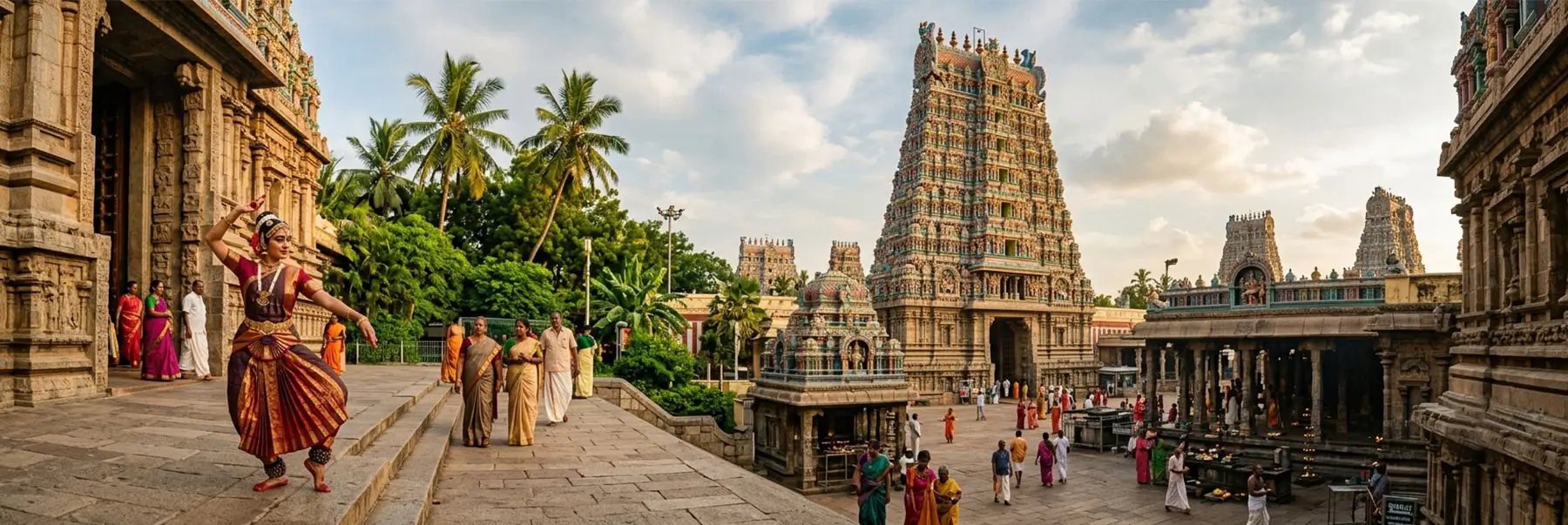
Madurai introduces another side of Tamil culture through the extraordinary Meenakshi Amman Temple, traditional markets, regional food and the everyday religious life surrounding one of India’s oldest continuously inhabited cities. The route then reaches Rameswaram, an important Hindu pilgrimage center connected with the Ramayana tradition, before travelling to Kanyakumari at the southern end of the Indian mainland. Here, coastal scenery and important religious landmarks create a fitting conclusion before returning to Chennai for the international departure.
Rather than presenting Tamil Nadu only as a collection of temples, the itinerary combines history, architecture, religion, colonial heritage, coastal landscapes, food and local life. Private transportation, carefully planned overnight stops and knowledgeable local guides make the tour suitable for European, American, Australian and other international travelers looking for a deeper introduction to South India.
Highlights
- Discover Chennai’s historic temples, colonial landmarks and coastal character.
- See the UNESCO World Heritage monuments of Mahabalipuram.
- Walk through Pondicherry’s French Quarter and atmospheric White Town.
- Visit the monumental Brihadisvara Temple at Thanjavur.
- Discover the vast Srirangam temple complex near Trichy.
- Spend two nights in Madurai, one of Tamil Nadu’s great cultural cities.
- Attend an evening temple ceremony in Madurai when operating conditions permit.
- Visit the sacred island town of Rameswaram and Ramanathaswamy Temple.
- Travel across the famous Pamban crossing towards Rameswaram.
- Visit the remains and coastal landscape around Dhanushkodi.
- Reach Kanyakumari at the southern tip of mainland India.
- See Vivekananda Rock Memorial and the Thiruvalluvar Statue from the Kanyakumari waterfront.
- Enjoy regional South Indian food and opportunities to observe local markets and daily life.
- Travel throughout the itinerary with private transportation and customizable sightseeing arrangements.
Itinerary
Arrive at Chennai International Airport, where you will be welcomed by our representative and assisted with your private transfer to the hotel. Chennai is the capital of Tamil Nadu and one of the principal gateways to South India, combining a long coastal history with temples, colonial architecture, commercial districts and modern urban life. After checking in, time will be allowed to rest after the international journey. The first day is deliberately kept comfortable so that overseas travelers can adjust before beginning the longer cultural route through Tamil Nadu.
According to the arrival time, begin sightseeing with Kapaleeshwarar Temple in Mylapore, one of Chennai’s best-known Hindu temples. Its colorful Dravidian gateway, sculptural details and active religious atmosphere provide an immediate introduction to Tamil temple architecture. Continue to San Thome Basilica, associated with the Christian tradition of St. Thomas the Apostle, before seeing the colonial surroundings of Fort St. George as permitted by current visiting arrangements. Together, these sites reveal the different religious and historical influences that have shaped Chennai over centuries.
Later, spend some time near Marina Beach, the long urban shoreline facing the Bay of Bengal. Rather than planning a demanding schedule on the arrival day, the evening can be used to observe Chennai at a relaxed pace before enjoying a South Indian dinner. Dishes based on rice, lentils, vegetables, coconut, tamarind and regional spices provide an early introduction to Tamil cuisine. Return to the hotel after dinner and rest before leaving Chennai the following morning.
Overnight: Chennai
After breakfast, leave Chennai and travel south along the coast towards Mahabalipuram, historically also known as Mamallapuram. The town became an important center under the Pallava rulers and is internationally recognized for its remarkable collection of rock-cut monuments and early structural temples. The relatively short journey allows plenty of time for sightseeing after arrival. Check into the hotel and begin exploring the archaeological landscape with a local guide who can explain the development of Pallava architecture and sculpture.
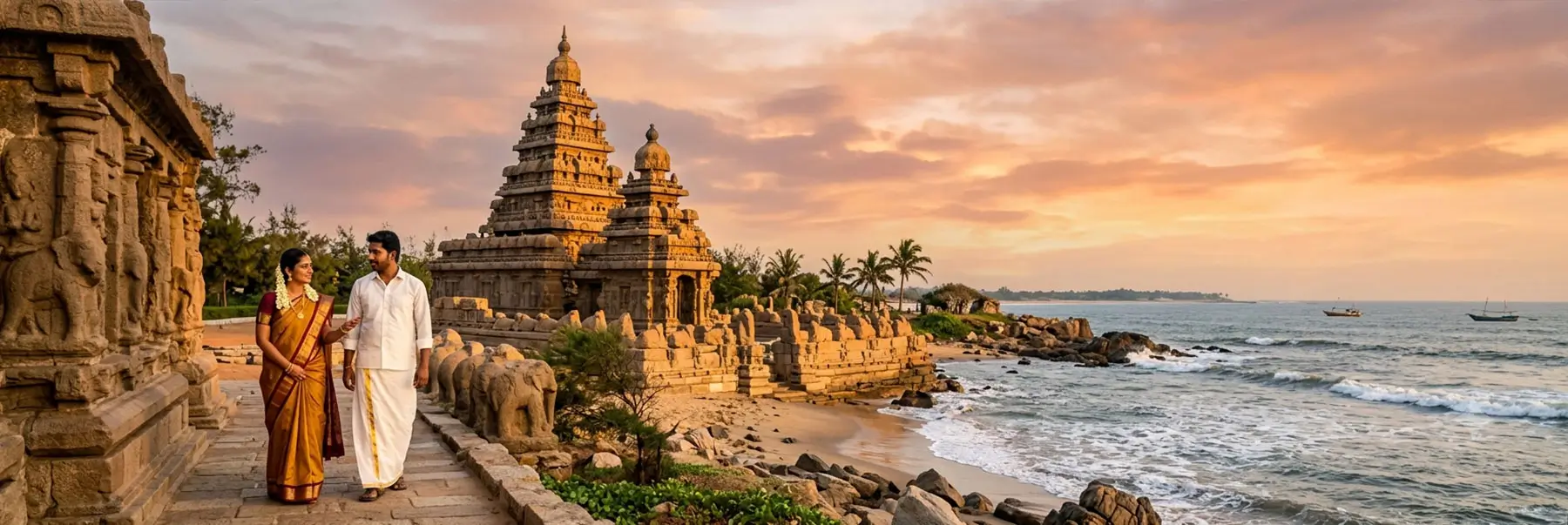
Visit the celebrated Shore Temple, standing close to the Bay of Bengal and forming one of South India’s most recognizable historical silhouettes. Continue to the Pancha Rathas, a remarkable group of monolithic structures carved from individual masses of granite. Although commonly called chariots, these monuments are architectural experiments demonstrating different forms that later influenced South Indian temple design. The guide will explain the sculptural details and historical background rather than presenting the monuments simply as photographic stops.
Continue to Arjuna’s Penance, the enormous open-air rock relief whose interpretation is connected with important Hindu narratives, before walking to the naturally balanced boulder popularly known as Krishna’s Butter Ball. Mahabalipuram rewards slow exploration because sculptural details appear throughout the landscape rather than inside a single monument. Towards evening, enjoy time near the coast and walk through the town at a relaxed pace. The sound of the sea beside centuries-old stone monuments gives Mahabalipuram a character very different from Chennai.
Overnight: Mahabalipuram
After breakfast, continue south along the Coromandel Coast towards Pondicherry, officially Puducherry. The journey introduces stretches of coastal Tamil Nadu before reaching a city whose architectural identity reflects both Tamil traditions and its long period of French colonial administration. On arrival, check into the hotel and allow some time to rest. Pondicherry is best appreciated on foot, particularly within its older quarters, where tree-lined streets, heritage buildings and the seafront create a slower atmosphere than the major cities of South India.
Begin with the French Quarter and White Town, where colonial-era façades, old villas, courtyards, churches and carefully laid-out streets retain traces of the city’s French past. Continue to the Sri Aurobindo Ashram, an important spiritual institution associated with Sri Aurobindo and Mirra Alfassa, widely known as The Mother. Visitors should maintain silence and follow the current rules concerning clothing, footwear, mobile phones and photography. The visit provides an opportunity to understand a spiritual movement that forms an important part of modern Pondicherry’s identity.
Later, visit the Basilica of the Sacred Heart of Jesus and spend time walking along the seafront promenade. The waterfront becomes particularly pleasant towards evening as local residents gather and temperatures become more comfortable. Pondicherry also provides an interesting dining experience because Tamil and French influences coexist alongside contemporary cafés and restaurants. Enjoy dinner according to your preference before returning to the hotel. The relatively relaxed evening provides a useful contrast before the journey turns inland towards Tamil Nadu’s great temple cities.
Overnight: Pondicherry
Leave Pondicherry after breakfast and travel through the Tamil countryside towards Thanjavur, historically known as Tanjore. The drive passes agricultural areas, smaller settlements and landscapes that reveal a quieter side of the state away from its larger cities. Thanjavur is closely associated with the Chola dynasty, whose rulers were responsible for some of the greatest achievements in South Indian temple architecture, sculpture and bronze casting. Arriving here marks an important transition from the colonial atmosphere of Pondicherry to the monumental heritage of medieval Tamil Nadu.
The principal visit is the magnificent Brihadisvara Temple, constructed during the reign of Rajaraja Chola I in the early eleventh century. Its enormous stone vimana, carefully organized temple complex, sculptures and inscriptions demonstrate the architectural ambition of the Chola period. Rather than simply photographing the main tower, take time to walk around the complex with a guide and understand how engineering, royal patronage, religion and artistic traditions came together in its construction. The temple forms part of UNESCO’s Great Living Chola Temples and remains an active place of worship.
Continue to the Thanjavur Maratha Palace complex and, according to current access arrangements, visit sections associated with the Saraswathi Mahal Library, known for its historic manuscript collections. Thanjavur is also associated with distinctive painting, bronze work and classical artistic traditions, and travelers interested in crafts may include an appropriate workshop or gallery visit when time permits. The evening is free for rest after the road journey, allowing visitors to absorb the very different historical character of the city before continuing towards Trichy and Madurai.
Overnight: Thanjavur
After breakfast, depart Thanjavur for Tiruchirappalli, commonly called Trichy. The main focus is the vast Sri Ranganathaswamy Temple at Srirangam, one of the most important Vaishnavite temple complexes in South India. Built and expanded across different historical periods, the complex contains multiple enclosures, monumental gateways, shrines and active religious spaces. Because access to certain inner areas may be restricted according to religious rules, foreign visitors should follow the guidance provided locally and respect areas reserved for Hindu worshippers.
Continue with a visit to Rockfort, a historic landmark rising above Trichy. The rock formation and temple structures provide insight into the city’s long strategic and religious history. Reaching higher sections involves climbing numerous steps, so the visit can be adjusted according to the traveler’s mobility and weather conditions. From elevated points, views extend across Trichy and the surrounding landscape, creating a strong contrast with the enclosed architectural spaces of Srirangam.
Later, continue by road to Madurai, one of Tamil Nadu’s most important historic and religious cities. After hotel check-in and some rest, head towards the old city and the surroundings of Meenakshi Amman Temple. When current temple schedules and access conditions permit, the evening can include the traditional night ceremony associated with Meenakshi and Sundareshwarar. Seeing the temple after dark introduces visitors to Madurai as a living pilgrimage city rather than merely an archaeological destination. Return to the hotel after the ceremony.
Overnight: Madurai
Begin the day with a detailed visit to Meenakshi Amman Temple, the religious and cultural heart of Madurai. Its monumental gopurams are covered with brightly painted sculptural figures, while the interior complex contains corridors, halls, shrines and active worship spaces. The temple has developed over centuries and remains deeply integrated into daily life in the old city. Non-Hindu visitors may not be permitted into every sacred section, and photography restrictions can apply, so the guide will help visitors understand both the architecture and the appropriate religious etiquette.
Continue to Thirumalai Nayak Palace, constructed in the seventeenth century and associated with the Nayak rulers of Madurai. Its large courtyard, columns and surviving architectural elements provide a secular counterpart to the city’s temple heritage. Later, visit the Gandhi Memorial Museum, subject to its current opening schedule, to gain broader historical context concerning Mahatma Gandhi and India’s independence movement. These visits demonstrate that Madurai’s importance extends beyond its famous temple.
The afternoon or early evening can be devoted to a local market and South Indian food experience. Madurai’s busy streets provide opportunities to observe flower sellers, fruit and vegetable markets, small shops and everyday commercial life. Depending on the selected arrangement, travelers can participate in a cooking demonstration, dine with a culinary focus, or sample carefully chosen regional dishes with guidance. Learning about dosa, idli, rice preparations, lentils, chutneys, spices and Tamil meal customs adds an important human dimension to the heritage journey. Return to the hotel after dinner.
Overnight: Madurai
After breakfast, leave Madurai and travel towards Rameswaram, one of India’s major Hindu pilgrimage destinations. The road gradually approaches the coast before crossing towards Pamban Island, creating a noticeable change in landscape. Rameswaram has deep associations with the Ramayana tradition and is considered sacred because of its connection with Lord Rama. For international travelers unfamiliar with Hindu mythology, the guide can explain the religious background without requiring participation in rituals.
Visit the celebrated Ramanathaswamy Temple, known particularly for its long pillared corridors and its importance within Hindu pilgrimage traditions. The complex contains sacred water tanks and ritual areas used by pilgrims. Visitors who are not participating in religious bathing can observe respectfully while following instructions concerning photography, clothing and access. As at other major temples, certain areas may be restricted to Hindus, and current temple regulations always take priority over the planned sightseeing schedule.
Later, see Agni Theertham along the seafront and spend time around the Pamban coastal landscape. Continue towards Dhanushkodi, subject to current road, weather and local access conditions. The remote coastal setting and remains associated with the former settlement create a striking atmosphere between sea and sand. The area was severely affected by the devastating 1964 cyclone, and its landscape today differs dramatically from the monumental temple setting of Rameswaram. Return to the hotel after the excursion.
Overnight: Rameswaram
After an early breakfast, depart Rameswaram for the longer drive to Kanyakumari, located at the southern end of mainland India. Today is primarily a travel day, but the changing scenery provides an opportunity to see towns, agricultural areas and coastal landscapes of southern Tamil Nadu. Suitable comfort stops will be made during the drive so the journey remains manageable for international travelers. On arrival in Kanyakumari, check into the hotel and take some time to rest before beginning local sightseeing.
Visit the waterfront associated with Kumari Amman Temple, an important pilgrimage site dedicated to the goddess Kanyakumari. Temple entry and access to particular areas are governed by religious rules, and visitors should dress modestly and follow local instructions. From the waterfront, views extend towards the Vivekananda Rock Memorial and Thiruvalluvar Statue, two of the town’s best-known landmarks. Boat services to the rock memorial depend on weather, sea conditions, crowd levels and operating schedules, so the visit will be arranged accordingly.
Towards evening, proceed to an appropriate viewpoint to watch the sunset over Kanyakumari. The location is celebrated for its broad coastal horizon and symbolic position at the southern end of the Indian mainland. Weather conditions naturally determine the quality of the sunset, but even without a perfectly clear sky, the gathering of visitors along the coast creates a memorable atmosphere. After a journey that began in Chennai and passed through temple cities, colonial quarters and pilgrimage centers, Kanyakumari provides a geographically distinctive final stop.
Overnight: Kanyakumari
After breakfast, enjoy a relaxed morning in Kanyakumari according to the flight schedule. If sea and operating conditions permit and the visit was not completed the previous day, take the ferry towards the Vivekananda Rock Memorial. The memorial commemorates Swami Vivekananda and stands on an offshore rock reached by public ferry. The nearby Thiruvalluvar Statue honors the celebrated Tamil poet and philosopher Thiruvalluvar. Waiting times can vary considerably during busy periods, so the day’s arrangements will remain coordinated with the confirmed flight.
Rather than undertaking an extremely long road journey from Kanyakumari all the way back to Chennai, the itinerary uses a more comfortable connection through Thiruvananthapuram (Trivandrum). Depart Kanyakumari by private vehicle and drive to Trivandrum Airport in neighboring Kerala. This routing substantially reduces road travel and is much more suitable for overseas travelers completing a ten-day itinerary. Depending on the selected flight, lunch and comfort stops will be arranged appropriately before reaching the airport.
Board the scheduled domestic flight from Trivandrum to Chennai. On arrival, meet the local representative and transfer privately to the Chennai hotel. The final evening is intentionally left free, allowing travelers to rest, organize luggage and prepare for the international journey home. Those with sufficient energy can enjoy a final South Indian dinner or spend the evening at the hotel. Keeping the last night in Chennai also provides a sensible buffer before the international departure.
Overnight: Chennai
Enjoy breakfast at the hotel according to the timing of your international flight. With no major sightseeing scheduled today, the morning remains relaxed and avoids the risk of a delayed monument visit interfering with the airport transfer. Travelers with a late departure can request additional Chennai sightseeing, shopping, a restaurant visit, or a late hotel checkout subject to availability and additional cost.
At the appropriate time, your private driver will collect you from the hotel for the transfer to Chennai International Airport. Assistance can be arranged according to the final booking requirements, and travelers should reach the airport with sufficient time for international check-in, security and immigration procedures.
The tour concludes after a route covering Tamil Nadu’s coastal cities, Pallava monuments, French colonial heritage, Chola architecture, active temple traditions, local cuisine, pilgrimage centers and the southern coastline. From Mahabalipuram’s ancient stone carvings and Thanjavur’s monumental temple to Madurai’s living religious traditions and Kanyakumari’s oceanfront setting, the journey provides a broad introduction to the history and culture of Tamil Nadu.
Tour Ends
 Inclusions
 Exclusions
Tell us about your
Travel Plans
Share your travel preferences and our destination specialists will create a personalized itinerary along with the best travel recommendations and pricing. Most inquiries receive a detailed response within 24 hours with no obligation.
Have a Question?
Whether you're planning a private tour, luxury holiday, family vacation, chauffeur-driven journey, hotel booking, or a customized India itinerary, our travel experts are ready to assist you.
Share your requirements and we'll provide the best travel options, recommendations, and pricing tailored to your needs.
Begin your
India journey
From the palaces of Rajasthan to the backwaters of Kerala - tell us where you wish to go. Our luxury travel experts at India Fortune Journey craft every itinerary to your pace, taste, and story.
Plan My Tour