How Much Does a Trip to India Cost for Foreign Tourists? Daily Budget by Travel Style
Tom, an accountant from Melbourne, does not book anything without a spreadsheet. When he and his partner Sarah began looking at India for a two-week holiday, his first search was simple: how much does a trip to India actually cost? The answers he found ranged from "you can do it on USD 20 a day" to "expect USD 1,000 a night", and none of them matched the kind of trip they had in mind. They wanted private transport, comfortable hotels with character, a few special evenings, and no hostel dormitories.
The truth is that the India trip cost for foreign tourists depends almost entirely on travel style. India can be one of the least expensive destinations in the world or one of the most lavish, often on the same street. A plate of food can cost ₹150 at a busy local eatery or ₹6,000 at a palace hotel restaurant across the road.
This guide sets out realistic daily budgets for four travel styles, adds the fixed costs you pay before you even land, and finishes with sample two-week totals. All prices are per person, based on two people travelling together, and are deliberately kept on the higher side for the October to March peak season.
The Fixed Costs Before You Land: Flights, Visa and Insurance
Before any daily budget starts, every visitor pays three fixed costs: international flights, the visa and travel insurance. These rarely change with travel style, so it makes sense to separate them from the rest.
International flights to India are the largest single expense for most travellers. Return economy tickets from London, Paris, Frankfurt, Milan or Madrid to Delhi typically cost USD 650 to USD 1,100 in peak season, with direct flights at the upper end. From New York, Chicago or Toronto, expect USD 950 to USD 1,600, usually with one connection through Europe or the Gulf. From Sydney or Melbourne, return fares run around USD 900 to USD 1,500. Premium economy roughly doubles these figures, and business class ranges from USD 3,500 to USD 7,000 depending on the airline and route. Booking three to four months ahead for December and January saves meaningful money, because fares around Christmas can jump by 40 percent.
The India e-Visa fee depends on nationality and validity. For most Western passports, the 30-day e-Tourist Visa costs USD 25 between July and March and USD 10 from April to June. The one-year visa costs USD 40, and the five-year visa USD 80. The official portal adds a bank charge of about 2.5 percent. Unofficial visa websites charge two or three times as much for the same document, so always apply through the government site.
Travel insurance with solid medical cover is essential. A two-week policy with cover for hospital treatment, evacuation and trip cancellation costs USD 60 to USD 150 per person for travellers under 60, rising to USD 150 to USD 300 for travellers over 70. Private hospitals in Indian cities are excellent but expensive for foreigners, and a single night in a good hospital can exceed USD 500.
Smaller fixed costs complete the picture. An Indian SIM card with 28 days of unlimited calls and around 2 GB of data per day costs ₹300 to ₹500 from Airtel or Jio, roughly USD 4 to USD 6, plus a passport photocopy and a photograph. Currency exchange at airport counters usually gives poor rates, so withdrawing from bank ATMs in the city is cheaper, though most foreign cards charge USD 3 to USD 5 per withdrawal.
For Tom and Sarah, flying from Melbourne in late January, the fixed costs came to roughly USD 1,350 each: USD 1,180 for flights, USD 25 for the visa and USD 145 for insurance. That figure sits outside every daily budget below, so add it to whatever travel style you choose.
Budget Comfort Travel: Daily Costs Around USD 70 to USD 110
This style suits independent travellers who want clean, safe rooms and some comfort without paying for luxury. It sits above backpacker level: no dormitories, no overnight buses, and private rooms with attached bathrooms throughout.
Accommodation in this tier means well-reviewed guesthouses, simple heritage homestays and branded budget hotels such as Ginger, Ibis or Treebo properties. Expect ₹3,000 to ₹5,500 per night for a double room with breakfast in Delhi, Agra, Jaipur, Udaipur and Varanasi. That works out to roughly ₹1,500 to ₹2,750 per person per night, or USD 18 to USD 32.
Food in India is outstanding value at this level. A full lunch at a good local restaurant costs ₹300 to ₹600 per person, and a relaxed dinner at a mid-range restaurant with a soft drink costs ₹700 to ₹1,200. Coffee shops in tourist areas charge ₹200 to ₹350 for a cappuccino. A realistic daily food budget is ₹1,500 to ₹2,200 per person, or USD 18 to USD 26.
Transport in this style mixes trains, app-based taxis and the occasional private car. The Delhi to Agra Gatimaan Express costs about ₹1,500 to ₹2,000 in Executive Chair Car. An air-conditioned chair car seat between Jaipur and Udaipur costs around ₹1,000. Uber and Ola rides within cities usually cost ₹200 to ₹600. Averaged over a trip, budget around ₹1,500 to ₹2,500 per person per day, or USD 18 to USD 30.
Sightseeing adds the final layer. Foreigner entry fees range from ₹200 for smaller sites to ₹1,300 for the Taj Mahal with its mausoleum. Licensed guides at major monuments cost ₹1,800 to ₹2,500 for a half day per group. Averaged over a trip, entry fees and occasional guides come to ₹800 to ₹1,500 per person per day.
Adding it up, budget comfort travel in India costs around USD 70 to USD 110 per person per day. The main trade-offs are time and energy. Booking trains, finding taxis and managing logistics yourself takes several hours a week, and train tickets on popular routes sell out weeks ahead in peak season.
This style works well for experienced travellers in their twenties and thirties, solo travellers comfortable with a little chaos, and anyone on a longer trip of three weeks or more. For first-time visitors with limited holiday time, the time saved by moving up one tier is often worth more than the money saved by staying here. Families with young children also tend to find this style tiring, because carrying luggage on and off trains with small children quickly wears down patience on both sides.
Mid-Range Private Travel: Daily Costs Around USD 160 to USD 280
This is the style most first-time visitors from Europe, North America and Australia end up choosing, and it is where Tom and Sarah settled. It combines a private car with driver, licensed guides in each city, and four-star or heritage boutique hotels, all arranged in advance.
Accommodation in this tier includes four-star chains such as Radisson Blu, Courtyard by Marriott and Crowne Plaza, along with heritage boutique hotels in Rajasthan that occupy restored mansions with courtyards and painted interiors. Expect ₹8,000 to ₹14,000 per night for a double room with breakfast in peak season, or ₹4,000 to ₹7,000 per person per night, which is USD 47 to USD 82.
Transport means a dedicated vehicle and driver for most of the trip. A Toyota Innova Crysta costs around ₹5,500 to ₹6,500 per day, including fuel, tolls, parking and the driver's allowances. Split between two people, that is about USD 33 to USD 38 each per day. Longer gaps, such as Delhi to Varanasi or Rajasthan to Kerala, are covered by domestic flights at ₹4,500 to ₹9,000 per seat one-way.
Guides cost ₹2,500 to ₹3,500 per full day per group for English speakers, and ₹3,500 to ₹5,000 for Italian, Spanish, French or German speakers. With a guide on most sightseeing days, the per-person average lands around USD 12 to USD 20 per day.
Food at this level usually means hotel breakfasts, lunch at good restaurants along the route and dinners at well-reviewed restaurants or the hotel's own dining room. Budget ₹2,500 to ₹4,000 per person per day, or USD 30 to USD 47.
Entry fees and extras, such as monument tickets, a sunset boat on Lake Pichola for about ₹900, a cooking class at ₹3,000 to ₹4,500 per person or a jeep safari, add another USD 15 to USD 30 per day on average.
All in, mid-range private travel in India costs around USD 160 to USD 280 per person per day. When booked as a package through a local operator, the price usually includes the hotels, car, guides and airport transfers. Meals and entry fees are often added separately, so check what the quote covers.
This tier offers the best balance of comfort and value. You avoid the logistics of public transport, you travel at your own pace, and you sleep in hotels that are pleasant places to return to after a long day of sightseeing. It is also the style where a good local operator adds the most value, because one phone call can fix a delayed train, a changed flight or a hotel issue that would otherwise eat half a day.
Luxury Travel: Daily Costs From USD 450 to Over USD 1,500
At the luxury end, India becomes one of the most rewarding high-end destinations in the world, largely because its palace hotels have no real equivalent elsewhere. Luxury travel in India comes in two broad bands.
Five-star luxury, the lower band, includes hotels such as ITC Maurya, Taj Palace, Trident, Fairmont and Leela properties in the major cities. Rooms cost ₹16,000 to ₹30,000 per night in peak season. Add a premium vehicle such as a Toyota Camry or Hycross at around ₹7,000 to ₹9,000 per day, senior guides at ₹3,500 to ₹5,000 per day, fine-dining dinners at ₹4,500 to ₹7,000 per person, and a few special experiences. The daily cost lands around USD 450 to USD 700 per person.
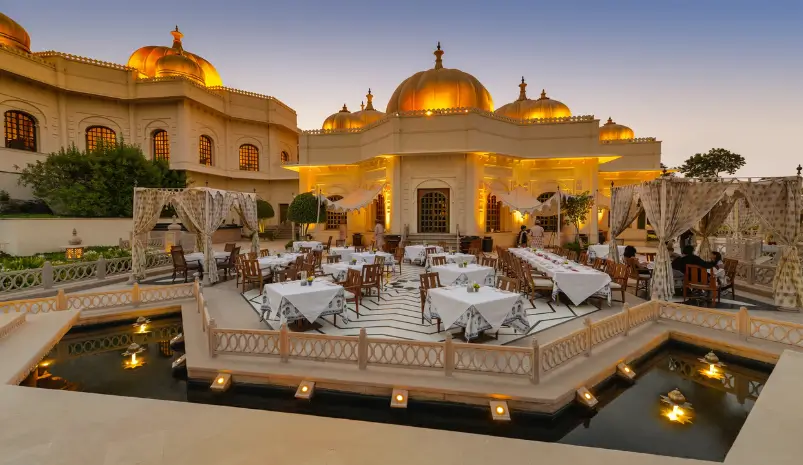
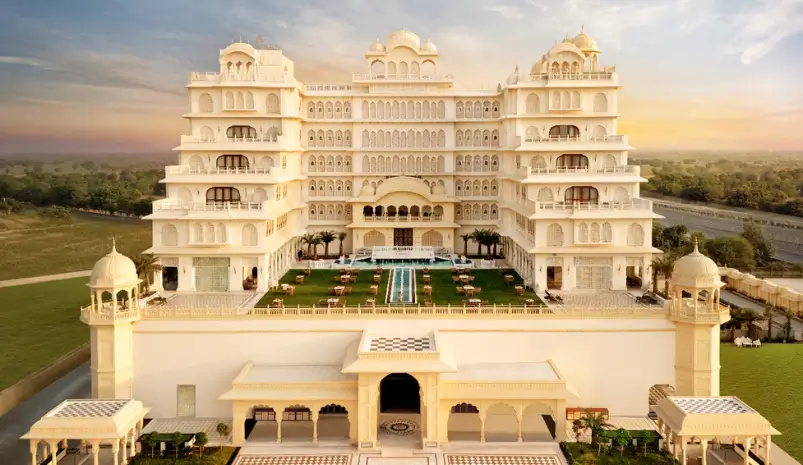
Palace luxury, the upper band, includes The Oberoi Amarvilas in Agra, Rambagh Palace and The Oberoi Rajvilas in Jaipur, Umaid Bhawan Palace in Jodhpur, and The Oberoi Udaivilas and Taj Lake Palace in Udaipur. Entry-level rooms here range from roughly ₹60,000 to ₹150,000 per night, and suites can exceed ₹300,000. Add a chauffeur-driven Mercedes E-Class at ₹16,000 to ₹22,000 per day, private specialist guides, palace dining at ₹8,000 to ₹15,000 per person per day, and private experiences such as a polo match, a private dinner on a fort rampart or a sunrise hot air balloon flight at around ₹16,000 to ₹20,000 per person. The daily cost reaches USD 900 to USD 1,500 or more per person.
Private aviation sits above even that. A helicopter transfer from Jaipur to a Rajasthan desert property or a private jet between Delhi and Udaipur can add USD 5,000 to USD 15,000 per sector, and is usually arranged for special celebrations.
What makes luxury in India distinctive is the gap between price and experience. A suite at a palace hotel in Udaipur costs less than a comparable room in Paris or New York, yet it comes with a boat transfer across a lake, staff who have served the same royal family for generations, and a setting no modern city hotel can match. Many luxury travellers combine one or two palace nights with five-star stays elsewhere, which keeps the average daily cost closer to USD 600 to USD 800 while keeping the highlights.
Peak timing affects this tier more than any other. Between 20 December and 5 January, palace hotels raise rates by 25 to 50 percent and add compulsory gala dinners of ₹25,000 to ₹45,000 per person. Booking at least four months ahead secures better room categories at standard rates.
Sample Two-Week Totals and Booking a Costed Trip with India Fortune Journey
Daily figures are useful, but most travellers want a single number. Here is what a two-week India trip cost realistically looks like per person, including international flights, the visa and insurance, for a trip covering Delhi, Agra, Rajasthan and Varanasi.
In budget comfort style, with 14 days at USD 70 to USD 110 plus about USD 1,000 to USD 1,350 in fixed costs, the total lands at roughly USD 2,000 to USD 2,900 per person.
In mid-range private style, with 14 days at USD 160 to USD 280 plus fixed costs, the total lands at roughly USD 3,250 to USD 5,300 per person. Tom and Sarah's final figure was USD 4,100 each. That covered four-star and heritage hotels, a private Innova Crysta for eleven days, one domestic flight to Varanasi, licensed guides in five cities and two special dinners.
In five-star luxury style, the total runs from about USD 7,300 to USD 11,000 per person, and in palace luxury style, from USD 13,500 to USD 22,000 or more, depending heavily on which properties and room categories are chosen.
A few habits keep costs under control in every style. Avoid the Christmas to New Year window if dates are flexible. Book domestic flights at least six weeks ahead. Ask whether monument fees and meals are included before comparing quotes. And spend the extra money on the two or three experiences that matter most to you rather than upgrading everything evenly. Finally, keep around ten percent of the total aside for the unexpected: an extra night somewhere you fall in love with, a doctor's visit for a stomach upset, or a beautiful textile you did not intend to buy. Travellers who build in that cushion consistently report a more relaxed trip, because every small surprise no longer feels like a budget emergency.
India Fortune Journey builds costed itineraries from its Jaipur office for travellers in the mid-range and luxury styles, with every hotel, vehicle, guide and inclusion listed line by line. If you share your travel dates, route ideas, preferred hotel level and rough budget, the team can show exactly what that budget buys, with alternatives at a higher and lower level for comparison. Get in touch by phone or WhatsApp at +91-8000722302 or by email at info@indiafortunejourney.com, and a detailed costed proposal usually arrives within 24 hours. Because every proposal comes with the exact hotel names and vehicle model, it is easy to compare against any other quote you receive, and the team is happy to adjust the route until the numbers sit comfortably within your budget.

15 Jun 2026

15 Jun 2026

15 Jun 2026

16 Jun 2026
06 Oct 2026
07 Oct 2026
08 Oct 2026
09 Oct 2026
10 Oct 2026
12 Oct 2026
Tell us about your
Travel Plans
Share your travel preferences and our destination specialists will create a personalized itinerary along with the best travel recommendations and pricing. Most inquiries receive a detailed response within 24 hours with no obligation.
Have a Question?
Whether you're planning a private tour, luxury holiday, family vacation, chauffeur-driven journey, hotel booking, or a customized India itinerary, our travel experts are ready to assist you.
Share your requirements and we'll provide the best travel options, recommendations, and pricing tailored to your needs.
Frequently asked questions
Everything foreign travellers usually ask an India tour. Still unsure? Just send us a message.
Excluding flights, expect around USD 70 to USD 110 per day for budget comfort, USD 160 to USD 280 for mid-range private travel, and USD 450 to over USD 1,500 for luxury.
Return economy fares from major European cities to Delhi usually cost USD 650 to USD 1,100 in peak season.
For most Western passports, the 30-day e-Tourist Visa costs USD 25 from July to March and USD 10 from April to June, plus a bank charge of about 2.5 percent.
About ₹1,500 to ₹2,200 per person per day at good local restaurants, or ₹2,500 to ₹4,000 at mid-range restaurants and hotels.
No. An Innova Crysta costs around ₹5,500 to ₹6,500 per day including fuel, tolls and driver allowances, about USD 33 to USD 38 per person for two travellers.
Including flights, about USD 2,000 to USD 2,900 for budget comfort, USD 3,250 to USD 5,300 for mid-range private travel and USD 7,300 or more for luxury.
April to June and the monsoon months of July to September offer the lowest hotel rates, although the heat and rain limit sightseeing in many regions.
Entry-level rooms at palace hotels such as Amarvilas, Rambagh Palace or Taj Lake Palace cost roughly ₹60,000 to ₹150,000 per night in peak season.
It is not a visa requirement, but medical cover is strongly advised. Two-week policies cost USD 60 to USD 150 for travellers under 60.
Yes. The team prepares itemised proposals listing hotels, vehicle, guides and inclusions, usually within 24 hours of an enquiry.
Begin your
India journey
From the palaces of Rajasthan to the backwaters of Kerala - tell us where you wish to go. Our luxury travel experts at India Fortune Journey craft every itinerary to your pace, taste, and story.
Plan My Tour