Ranthambore Safari Price: Jeep vs Canter Fares, Zones and Online Booking
James had travelled from Cape Town with one goal for his India trip: to see a wild tiger. He had spent years on safari in Kruger and the Okavango, but the Bengal tiger had always eluded him. When he began booking Ranthambore, he found a confusing world of options. There were jeep seats and canter seats, zones numbered one to ten, an official government portal and dozens of agents selling the same safari at wildly different prices. One agent quoted ₹3,000 per seat. Another quoted ₹25,000 for the whole jeep. A third offered a "guaranteed tiger zone" for more.
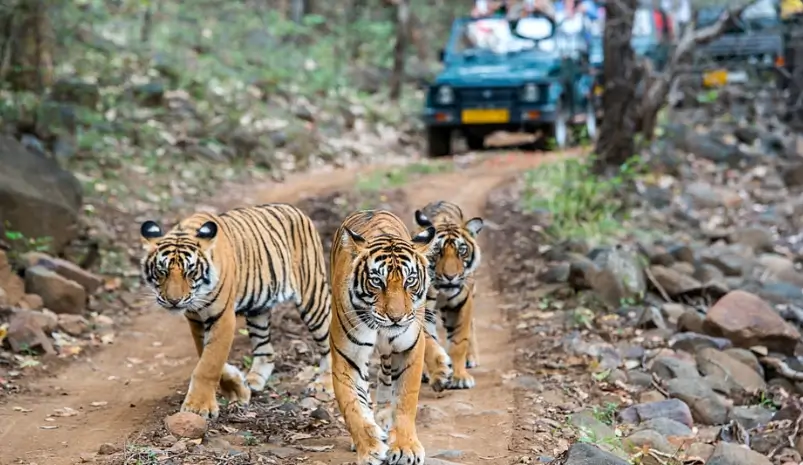
The Ranthambore safari price depends on four things: the vehicle type, whether you share or book the whole vehicle, the zone and how you book. Ranthambore National Park in eastern Rajasthan is one of the best places in the world to see wild tigers. Its dry deciduous forest, ancient fort and scattered lakes create open landscapes where tigers are easier to spot than in denser jungles. That popularity also means safaris sell out early in peak season.
This guide explains every option clearly. It covers fares for foreigners in jeeps and canters, the difference between zones, safari timings through the year, and the safest way to book online without losing your slot.
Ranthambore Safari Price for Foreigners: Jeep Seat, Canter Seat and Full Jeep
Safaris in Ranthambore run in two vehicle types, and both are operated under the Rajasthan Forest Department's rules. Each vehicle carries a trained naturalist guide and a licensed driver, and both are included in the safari price.
A jeep, also called a gypsy, carries up to six passengers. When booked through the official Rajasthan Forest Department portal, a foreigner jeep seat costs around ₹2,500 to ₹3,000 per person per safari, including the park entry fee, the vehicle, the driver and the guide. Through agents and hotels, the same seat usually costs ₹4,500 to ₹8,000 per person, because the agent adds charges for managing the booking, hotel pickup and support. Some of that premium is worth paying, especially if the agent handles last-minute zone allocation or provides an experienced naturalist.
A canter is an open-top bus with 20 seats. Through the official system, a foreigner canter seat costs around ₹2,000 per person per safari. Through agents, it usually costs ₹3,500 to ₹6,000. Canters are cheaper but slower, noisier and less flexible, as explained in the next section.
Many travellers, especially photographers and families, prefer to book an entire jeep exclusively. That means paying for all six seats, even if fewer people travel, so the group is not mixed with strangers and the guide can focus on its interests. A full jeep for foreigners costs around ₹18,000 to ₹25,000 per safari through a reputable operator in peak season, rising on holiday weekends.
At the top end, Ranthambore offers full-day and half-day exclusive safaris, where a jeep enters the park at sunrise and stays inside through the middle of the day, moving across several zones. These are limited in number and expensive. A full-day exclusive jeep for foreigners often costs well above ₹60,000 and can reach ₹100,000 or more in peak demand. They are aimed at serious photographers and wildlife enthusiasts.
A few smaller costs complete the picture. Video cameras are usually charged an extra fee of ₹400 to ₹600 per safari, while still cameras are free. Tips for the driver and naturalist guide are customary, around ₹300 to ₹500 each per safari for a shared jeep, or ₹500 to ₹1,000 each for an exclusive jeep. Some hotels charge ₹500 to ₹1,000 for packed breakfasts or tea on morning safaris.
James chose to share jeep seats for his first two safaris and booked an exclusive jeep for the third. His total safari spend over three drives came to about ₹33,000, including tips. On the third drive, a tigress walked out of the grass beside a lake, sat down and watched the jeep for four minutes before moving on.
Plan Your Ranthambore Safari with Confidence
Ready to experience the wild beauty of Ranthambore National Park? Let us help you understand safari prices, compare Gypsy and Canter options, and navigate the online booking process. Get personalized assistance with your travel dates, safari preferences and permit arrangements for a smoother wildlife adventure in Rajasthan.
Jeep Versus Canter: Which Safari Vehicle to Book
For most visitors, the choice between jeep and canter in Ranthambore comes down to comfort, flexibility and how serious you are about seeing a tiger.
The jeep is smaller, quieter and more manoeuvrable. It can stop instantly, reverse to reposition for a better view and take narrower forest tracks. With only six passengers, everyone has a good seat, and the naturalist can talk easily to the whole group. Jeeps are also allowed on more routes within each zone, which increases the chances of finding animals. For photographers, a jeep is almost essential, because a stable seat at the edge of the vehicle gives clear angles without other passengers in the frame.
The canter is larger, carries up to 20 passengers and moves more slowly. Its height gives a slightly better view over grass, but it cannot turn quickly or follow narrow tracks. With 20 people, it is noisier, and wildlife sometimes moves away before the canter arrives. Canters also take longer at the entry gate and between hotel pickups, which shortens the time inside the park. Their main advantages are lower cost and wider availability. When jeep seats are sold out on peak dates, canter seats often remain.
Who should choose which? Jeeps suit couples, photographers, families with children who need space and anyone visiting Ranthambore once and hoping for the best chance of a tiger sighting. Canters suit budget travellers, larger groups travelling together and visitors who mainly want a jungle experience, with a tiger sighting as a bonus rather than the goal.
Tiger sighting chances are a common question. In peak season between November and April, visitors who take three or four jeep safaris have roughly a 60 to 75 percent chance of at least one tiger sighting, depending on the zones allocated and the season. One safari alone gives a chance of perhaps 30 to 50 percent. April and May, when the heat draws tigers to waterholes, often give the best sightings, though temperatures inside the park can exceed 40°C by late morning.
Beyond tigers, Ranthambore is rich in wildlife. Leopards, sloth bears, striped hyenas, marsh crocodiles, sambar and spotted deer, blue bull antelope and more than 300 bird species live in the park. Even a safari without a tiger is rarely disappointing, especially with a good naturalist who reads tracks and alarm calls.
Ranthambore Fort, a UNESCO World Heritage Site inside the park, is another highlight. It can be visited separately by road from the park entrance without a safari ticket, and early morning visits often bring sightings of grey monkeys and birds of prey from the ramparts.
Ranthambore Safari Zones and Timings Through the Season
Ranthambore is divided into ten safari zones, and your zone allocation affects both what you see and how you book.
Zones 1 to 5 form the core area, with the oldest forest, the three famous lakes below the fort, the ruins near the fort and the highest tiger density. They are the most requested zones and the hardest to book. Zones 3 and 4, around the lakes, have historically produced many of the park's most famous sightings and photographs.
Zones 6 to 10 lie on the periphery and buffer areas. They are larger, less crowded and sometimes overlooked, yet several resident tigers live there, and sightings in these zones have improved greatly in recent years. Zones 6 and 7 in particular are known for regular sightings. Because demand is lower, booking these zones is easier and often possible at shorter notice.
Under the official system, zones are allocated by the forest department, not chosen freely when booking a shared seat. Booking early gives the best chance of a core zone, but allocation is not guaranteed. Be wary of agents who promise a "guaranteed tiger zone" for an extra fee, because no one can guarantee a sighting.
Safari timings change with the season to match sunrise and sunset. Each day has two shifts, a morning safari and an afternoon safari, each lasting about three to three and a half hours. In October, morning safaris run from about 6:30 am to 10:00 am and afternoon safaris from 2:30 pm to 6:00 pm. From November to January, morning safaris run from about 7:00 am to 10:30 am and afternoon safaris from 2:00 pm to 5:30 pm. From February to March, the morning shift returns to about 6:30 am to 10:00 am, with afternoons from 2:30 pm to 6:00 pm. From April to June, morning safaris start as early as 6:00 am and end at 9:30 am, with afternoons from 3:00 pm to 6:30 pm. Pickups from hotels are usually 20 to 30 minutes before the shift starts.
The season matters too. The core zones 1 to 5 are closed from 1 July to 30 September for the monsoon breeding season. The peripheral zones remain open, subject to weather. The park is cold on winter mornings, often 5°C to 8°C at dawn in December and January, so a warm jacket, gloves and a hat are essential in an open jeep. Hotels often supply blankets.
The best months for comfort are October, November, February and March. The best months for sightings are April and May, while December and January offer misty, atmospheric mornings and beautiful light for photography.
Plan Your Safari Around Dates and Zone Availability
Your safari date and permit availability play an important role in planning a Ranthambore visit. Explore the booking requirements, review available vehicle options and check the applicable zone arrangements before confirming your plans. Reach out for help organizing your visit around your preferred dates.
Booking Ranthambore Safari Online Without Losing Your Slot
Ranthambore safari online booking through the official Rajasthan Forest Department portal opens months in advance. For peak dates between October and March, shared jeep seats in the core zones often sell out 60 to 90 days ahead, and the Christmas, New Year and long-weekend dates can sell out even earlier.
To book officially, you need the full name, nationality, passport number and age of every traveller, plus the date and shift of the safari. The names and passport numbers are checked at the park gate, and changes after booking are generally not allowed. A small spelling error or a swapped passport can lead to a refused entry, so double-check every detail. Cancellations usually lose most or all of the fee, depending on how close to the date you cancel.
Many foreign travellers book through a hotel or a tour operator rather than the official portal directly. A reputable operator books the official seats in your names, manages zone requests, arranges hotel pickup and supplies the naturalist's contact. You pay a premium over the bare government fare, but you avoid the complexity of the portal, which can be slow and occasionally rejects foreign cards.
A small number of seats are also released through a last-minute current booking quota at the forest office near the park entrance, usually the day before or the morning of the safari, at a higher fee. Availability is unpredictable, and queues can start very early, so this should be a backup rather than the main strategy.
Accommodation near the park ranges widely. Comfortable jungle lodges and resorts cost about ₹8,000 to ₹15,000 per night, upscale options such as the Taj Sawai Madhopur Lodge about ₹25,000 to ₹40,000, and luxury properties such as The Oberoi Vanyavilas and the tented resorts on the park's edge about ₹70,000 to ₹120,000 per night. Two nights allow three or four safaris, which most visitors find ideal. Many lodges include breakfast and dinner in their rates, which suits safari days, because the morning drive returns around 10:30 am and the afternoon drive ends close to sunset, leaving little time to eat out. Some lodges also run their own nature walks, bird-watching sessions around the property and evening talks by naturalists, which add value at no extra cost.
Reaching Ranthambore is easy. Sawai Madhopur is about three hours by road from Jaipur, four hours from Agra and six hours from Delhi. Trains from Delhi and Jaipur also stop at Sawai Madhopur station, about 15 minutes from most lodges.
Making the Most of a Ranthambore Safari with India Fortune Journey
A few habits improve every tiger safari in Ranthambore. Book at least three safaris to improve your chances, and mix morning and afternoon shifts. Wear neutral colours rather than bright ones, keep voices low and follow the naturalist's instructions. Carry binoculars, a zoom lens if you have one, sunscreen, a scarf against the dust and warm layers on winter mornings. Avoid using a phone's flash or making sudden noises near animals.
Respect the rules inside the park. Stepping out of the vehicle, feeding animals, littering and playing music are all forbidden, and drivers can lose their licences for breaking them. A good naturalist will keep a respectful distance from wildlife and will not chase a tiger with the jeep, even when other visitors insist. If a naturalist does break those rules, report it to your operator, because responsible guiding is part of what you are paying for and it protects the park for future visitors. Patience is also rewarded here: sitting quietly near a waterhole for twenty minutes often produces more than racing between reported sightings.
James had one more piece of advice. On his first two safaris, he spent most of the time looking for tigers and almost missed the rest of the park: the leopard on a rock ledge, the crocodiles in the lake, the kingfishers diving into the water. On the third safari, he relaxed, enjoyed the forest and saw the tiger. He never decided whether those two facts were connected.
India Fortune Journey arranges Ranthambore tiger safaris from its Jaipur base, either as a same-day trip from Jaipur or as part of longer Golden Triangle and Rajasthan tours. Safari seats are booked officially in your names, with exclusive jeeps arranged for photographers and families on request. The team pairs safaris with suitable lodges in every budget, from comfortable jungle resorts to Oberoi Vanyavilas, and sends safari details, pickup times and the naturalist's contact before you arrive.

15 Jun 2026

15 Jun 2026

15 Jun 2026

16 Jun 2026
06 Oct 2026
07 Oct 2026
08 Oct 2026
09 Oct 2026
10 Oct 2026
12 Oct 2026
Tell us about your
Travel Plans
Share your travel preferences and our destination specialists will create a personalized itinerary along with the best travel recommendations and pricing. Most inquiries receive a detailed response within 24 hours with no obligation.
Have a Question?
Whether you're planning a private tour, luxury holiday, family vacation, chauffeur-driven journey, hotel booking, or a customized India itinerary, our travel experts are ready to assist you.
Share your requirements and we'll provide the best travel options, recommendations, and pricing tailored to your needs.
Frequently asked questions
Everything foreign travellers usually ask an India tour. Still unsure? Just send us a message.
Through the official portal, a jeep seat costs around ₹2,500 to ₹3,000 per person and a canter seat around ₹2,000. Through agents, jeep seats usually cost ₹4,500 to ₹8,000.
An exclusive six-seat jeep for foreigners costs about ₹18,000 to ₹25,000 per safari in peak season through a reputable operator.
A jeep is better for comfort, flexibility, photography and sighting chances, while a canter is cheaper and suits budget travellers and large groups.
Zones are allocated by the forest department. Booking early improves your chances of a core zone, but no zone is guaranteed.
Morning safaris run roughly 6:30 am to 10:00 am and afternoon safaris 2:00 pm to 6:00 pm, varying by month.
The core zones 1 to 5 are closed from 1 July to 30 September. The peripheral zones remain open, subject to weather.
Three or four safaris give roughly a 60 to 75 percent chance of a tiger sighting in peak season.
Generally no. Names and passport numbers are checked at the gate, so details must be correct at the time of booking.
April and May usually offer the best sightings, while October to March offer more comfortable weather.
Yes. Same-day safari trips from Jaipur and longer stays with lodges are arranged, with seats booked officially in your names.
Begin your
India journey
From the palaces of Rajasthan to the backwaters of Kerala - tell us where you wish to go. Our luxury travel experts at India Fortune Journey craft every itinerary to your pace, taste, and story.
Plan My Tour