Ranthambore vs Jim Corbett: Which Park Gives Better Tiger Sightings
Ingrid and Mats, wildlife photographers from Stockholm, had exactly four days for tigers in a three-week India trip, and they could not decide between India's two most famous tiger parks. A friend swore by Ranthambore, where she had photographed a tigress on the steps of an old pavilion beside a lake. A Swedish photography forum insisted that Jim Corbett, with far more tigers, was the serious wildlife choice. Both were right in their own way, which only made the decision harder.
The Ranthambore vs Jim Corbett question is one of the most common among foreign wildlife lovers. On paper, Corbett looks like the obvious winner, with roughly three times as many tigers. In practice, many visitors see tigers more easily in Ranthambore. The reason lies in the forests themselves, and in how each park is organised, priced and reached.
This guide compares the two parks across landscape, tiger numbers and sighting chances, zones and safari prices, seasons, accommodation and how each fits into a wider India itinerary. Prices are for foreign visitors in peak season and kept on the higher side.
Two Very Different Forests: Landscape and Tiger Numbers
The two parks could hardly look more different, and that difference shapes every safari.
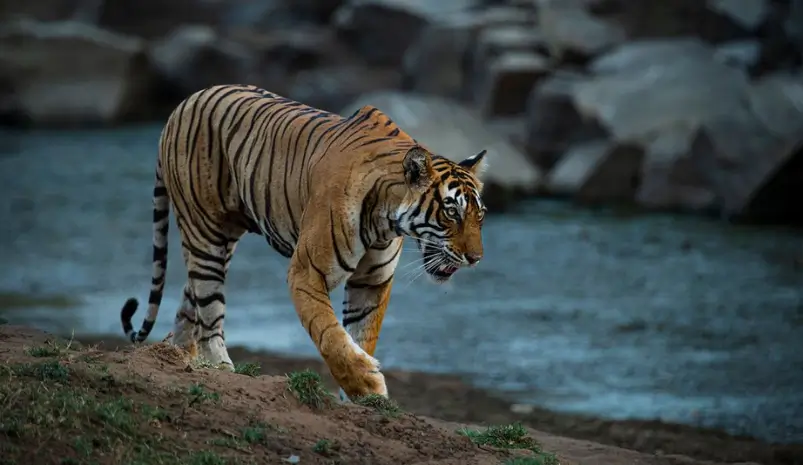
Ranthambore National Park lies in eastern Rajasthan, at the meeting point of the Aravalli and Vindhya hills. Its forest is dry deciduous, dominated by hardy anogeissus trees that shed their leaves in the dry months, with open grasslands, rocky ridges, ancient banyan trees and three large lakes below a thousand-year-old hilltop fort. Scattered ruins, old hunting pavilions and crumbling gateways lie throughout the park, which is why Ranthambore photographs are so distinctive. A tiger walking past a ruined arch or resting by a lake against the fort walls is a picture no other park can offer. The reserve holds roughly 75 to 85 adult tigers, spread across its core and buffer areas.
Jim Corbett National Park lies in the foothills of the Himalayas in Uttarakhand, about 250 kilometres north-east of Delhi. It is India's oldest national park and one of its most celebrated. Its landscape is moist and green, with dense hardwood forests, wide riverbeds, grassland plains and the Ramganga river and its reservoir running through the heart of the park. The Himalayan ridges rise behind it on clear days. The Corbett Tiger Reserve holds around 250 to 260 tigers, one of the highest densities of any reserve in the world.
Beyond tigers, the two parks offer very different wildlife. Ranthambore is known for leopards on rocky outcrops, sloth bears, striped hyenas, marsh crocodiles in the lakes, sambar and spotted deer, and around 300 bird species. Corbett offers something Ranthambore cannot: wild Asian elephants, often in herds of twenty or more along the river. It also has slender-snouted river crocodiles and marsh crocodiles, otters, king cobras, Himalayan black bears in the upper reaches, and more than 600 bird species, making it one of Asia's great birding destinations.
The atmosphere differs too. Ranthambore feels like an ancient landscape where history and wildlife share the same ground. Corbett feels like a wilder, more remote forest, with the sound of rivers and the calls of elephants in the distance.
Ingrid and Mats realised that their choice depended on what they wanted to photograph. Ranthambore offered tigers against ruins and lakes. Corbett offered tigers in dense forest and grassland, plus elephants and birds. Both were extraordinary, but they were not the same experience. Ranthambore also tends to feel busier in peak season, with more vehicles converging on reported sightings, while Corbett's larger area spreads visitors more thinly, which many photographers appreciate.
Tiger Sighting Chances in Ranthambore and Corbett
If the main question is simply which park gives better tiger sightings, Ranthambore usually wins, despite having fewer tigers.
The reason is visibility. Ranthambore's dry deciduous forest loses much of its foliage from February to June, and its open grasslands, lake shores and rocky terrain leave tigers with fewer places to hide. Tigers in Ranthambore are also famously relaxed around safari vehicles. Several generations have grown up seeing jeeps every day, and some well-known tigresses have raised cubs within sight of the tracks. On a peak-season visit with three or four jeep safaris, visitors have roughly a 60 to 75 percent chance of at least one tiger sighting. April and May, when tigers stay near water, often push that higher.
Corbett's tigers are more numerous but harder to see. The dense hardwood forest, tall grass and wide reserve allow tigers to stay out of sight easily, and many are more wary of vehicles. In most zones, three or four safaris give roughly a 30 to 50 percent chance of a tiger sighting, depending heavily on the zone and season. The exception is Dhikala, the famous zone deep inside the park. Its vast grasslands along the Ramganga river offer some of the best tiger sightings in northern India, especially from March to June. Visitors who stay overnight at the Dhikala forest lodge and take several safaris there can match or even exceed Ranthambore's odds.
Season affects both parks. In both, the best sighting months are March to June, when the heat draws tigers to water and the forest thins. The coolest and most comfortable months, November to February, have lower but still good chances, with beautiful misty mornings.
Sightings are never guaranteed anywhere. Ingrid and Mats heard plenty of stories from visitors who saw tigers on every safari in Corbett and none in Ranthambore, and the reverse. Wildlife does not follow statistics. But for travellers with only a few safaris, Ranthambore offers the more reliable odds, while Corbett rewards those with more time, especially in Dhikala. The skill of the naturalist matters in both parks, because an experienced guide who reads pugmarks, alarm calls and the behaviour of deer can turn an average safari into a successful one.
Leopards follow a similar pattern. They are seen fairly often in Ranthambore on rocky ridges and around the fort, and less often in Corbett. Elephants reverse the picture completely: they are frequent in Corbett and absent from Ranthambore. For travellers who want both big cats and big herds, Corbett's mix can be more rewarding, even with fewer tiger sightings.
Zones, Safari Types and Prices Compared
Both parks divide visitors into zones, and how those zones work affects both your experience and the tiger safari price.
Ranthambore has ten zones. Zones 1 to 5 form the core, with the lakes, the fort and the highest tiger density, while zones 6 to 10 lie in the periphery. Safaris run in six-seat jeeps or twenty-seat open canters, with two shifts a day of about three to three and a half hours each. Through the official Rajasthan portal, a foreigner jeep seat costs about ₹2,500 to ₹3,000 and a canter seat about ₹2,000. Through agents, jeep seats cost ₹4,500 to ₹8,000, and an exclusive jeep for foreigners costs about ₹18,000 to ₹25,000 per safari. Zones are allocated by the forest department and cannot be chosen freely.
Jim Corbett has several zones, each with its own entry gate. Dhikala is the largest and most famous zone. Overnight stays at the forest lodge inside, with safaris from the lodge, are the most sought-after experience in the park. Day visitors to Dhikala usually travel by canter. Bijrani is a popular zone with mixed forest and grassland, open from mid-October to June. Jhirna and Dhela are open throughout the year and suit visitors in the summer and monsoon months. Durga Devi is known for birds and the river, while Garjia and Sitabani are smaller zones on the edges.
In Corbett, jeeps are booked as whole vehicles of up to six people rather than individual seats. For foreigners, a full jeep safari including permit, vehicle and naturalist costs roughly ₹10,000 to ₹15,000 per safari through reputable operators in peak season. Dhikala overnight stays require booking accommodation at the forest lodge through the Uttarakhand forest portal, often 45 days or more in advance. Rooms there are simple, but the location is unmatched, and foreigner rates are significantly higher than Indian rates.
Comparing costs for four safaris for a couple, Ranthambore with shared jeep seats costs about ₹36,000 to ₹64,000 through agents, while Corbett with whole jeeps costs about ₹40,000 to ₹60,000. With an exclusive jeep for all four safaris, Ranthambore costs ₹72,000 to ₹100,000. In other words, the parks cost broadly similar amounts for serious safari time, although Ranthambore offers a cheaper entry point through shared seats.
Both parks charge extra for video cameras and expect tips for drivers and naturalists, usually ₹300 to ₹500 each per safari. In both parks, booking early is the single best way to keep costs under control, because late bookings often leave only expensive exclusive jeeps or agent premiums as options.
Access, Season, Lodges and Fitting Each Park into Your Route
How each park fits your wider India trip often decides the choice more than tiger numbers do.
Ranthambore fits easily into the Golden Triangle and Rajasthan. Sawai Madhopur, the town beside the park, is about three hours by road from Jaipur, four hours from Agra and six hours from Delhi. Trains from Delhi and Jaipur also stop there. That makes it simple to insert two nights of safaris between Jaipur and Agra, which is why so many first-time visitors to India include it.
Jim Corbett fits more naturally with northern India and the Himalayan foothills. Ramnagar, the gateway town, is about six to seven hours by road from Delhi, or reachable by overnight or early morning train to Ramnagar or Kathgodam. Corbett combines well with Rishikesh and Haridwar for yoga and spiritual travel, with the hill stations of Nainital and Ranikhet, or with a Himalayan trekking trip. It is harder to combine with Rajasthan, because travel between the two takes a full day each way.
The seasons also differ. Ranthambore's core zones are closed from 1 July to 30 September, and the park is at its best from October to June. Corbett's main zones are seasonal too. Dhikala opens from mid-November to mid-June, Bijrani from mid-October to June, while Jhirna and Dhela stay open all year. Winter mornings are cold in both parks, and Corbett is colder, at around 3°C to 6°C at dawn in January, so warm layers are essential in open jeeps.
Accommodation ranges widely in both. Around Ranthambore, comfortable jungle resorts cost ₹8,000 to ₹15,000 per night, the Taj Sawai Madhopur Lodge about ₹25,000 to ₹40,000, and luxury properties such as The Oberoi Vanyavilas and the tented resorts on the edge of the park about ₹70,000 to ₹120,000. Around Corbett, riverside resorts along the Kosi river cost ₹8,000 to ₹18,000, the Taj Corbett Resort and similar upscale properties about ₹25,000 to ₹45,000, and the simple forest lodges inside Dhikala offer the most memorable setting at modest comfort.
Ingrid and Mats finally chose both. They spent two nights at Ranthambore at the start of their Rajasthan section, taking four safaris and photographing a tigress on the second morning. Later, they spent three nights in Corbett, two of them inside Dhikala, before heading to Rishikesh. Their best tiger photograph came from Ranthambore, but their favourite memory was a herd of thirty elephants crossing the Ramganga river at sunset in Corbett.
Making the Choice and Booking with India Fortune Journey
Here is a simple way to choose between Ranthambore and Jim Corbett.
Choose Ranthambore if your trip includes the Golden Triangle or Rajasthan, if you have two or three days for safaris and want the best odds of seeing a tiger, if you love photographs of tigers against lakes and ruins, or if you are travelling with children or older relatives who prefer shorter drives and comfortable lodges.
Choose Jim Corbett if your trip focuses on northern India, Rishikesh or the Himalayan foothills, if you want a wider wildlife experience with elephants, river life and outstanding birding, or if you can stay longer, especially inside Dhikala, where tiger chances rival Ranthambore's.
Choose both if wildlife is the main reason for your trip and you have three weeks or more, linking Corbett with the north and Ranthambore with Rajasthan.
Whichever you choose, book early. Ranthambore's peak-season jeep seats and Corbett's Dhikala lodge rooms both sell out months in advance. Book at least three safaris, mix morning and afternoon shifts, and travel with realistic expectations. The forest itself, with its birds, deer, crocodiles and quiet morning light, is a reward even on days when the tiger stays hidden. Pack neutral-coloured clothing, binoculars, a dust scarf and warm layers for early starts, and keep phones on silent inside the park. Respect the rules on distance and noise, because both parks fine drivers and guides who break them, and calm behaviour around wildlife also gives everyone in the vehicle a better sighting. Families with children should choose morning safaris, when animals are most active and temperatures are pleasant, and keep afternoons free for rest at the lodge.
India Fortune Journey, based in Jaipur, arranges tiger safaris in Ranthambore as a same-day trip from Jaipur or as part of Golden Triangle and Rajasthan tours, and in Jim Corbett as part of northern India and Himalayan itineraries. Safari permits are booked officially in your names, exclusive jeeps can be arranged for photographers, and the team pairs each park with suitable lodges in every budget. Itineraries are arranged around zone seasons and closures, so your safari days always fall when the best zones are open.

15 Jun 2026

15 Jun 2026

15 Jun 2026

16 Jun 2026
06 Oct 2026
07 Oct 2026
08 Oct 2026
09 Oct 2026
10 Oct 2026
12 Oct 2026
Tell us about your
Travel Plans
Share your travel preferences and our destination specialists will create a personalized itinerary along with the best travel recommendations and pricing. Most inquiries receive a detailed response within 24 hours with no obligation.
Have a Question?
Whether you're planning a private tour, luxury holiday, family vacation, chauffeur-driven journey, hotel booking, or a customized India itinerary, our travel experts are ready to assist you.
Share your requirements and we'll provide the best travel options, recommendations, and pricing tailored to your needs.
Frequently asked questions
Everything foreign travellers usually ask an India tour. Still unsure? Just send us a message.
Ranthambore usually offers better odds, with roughly a 60 to 75 percent chance over three or four jeep safaris, compared with 30 to 50 percent in most Corbett zones.
Yes. Corbett holds around 250 to 260 tigers, while Ranthambore holds roughly 75 to 85, but Corbett's dense forest makes them harder to see.
Dhikala, with its wide grasslands along the Ramganga river, especially from March to June for visitors staying overnight inside the zone.
No. Wild elephants live in Corbett but not in Ranthambore.
A full jeep for up to six people costs roughly ₹10,000 to ₹15,000 per safari for foreigners through reputable operators.
About ₹2,500 to ₹3,000 per seat through the official portal, ₹4,500 to ₹8,000 through agents, or ₹18,000 to ₹25,000 for an exclusive jeep.
Ranthambore, which is about three hours from Jaipur and four hours from Agra, compared with Corbett's six to seven hours from Delhi.
Ranthambore's core zones close from July to September. In Corbett, Dhikala opens from mid-November to mid-June and Bijrani from mid-October to June.
Jim Corbett, with more than 600 bird species, is one of Asia's finest birding destinations.
Yes. Safaris in Ranthambore and Jim Corbett can be booked individually or combined in a wildlife itinerary.
Begin your
India journey
From the palaces of Rajasthan to the backwaters of Kerala - tell us where you wish to go. Our luxury travel experts at India Fortune Journey craft every itinerary to your pace, taste, and story.
Plan My Tour