
- /
- Fair & Festivals
- / Lathmar Holi in Barsana and Nandgaon
Lathmar Holi in Barsana and Nandgaon
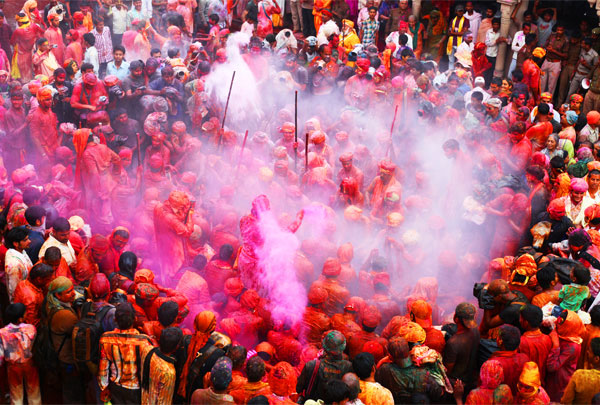
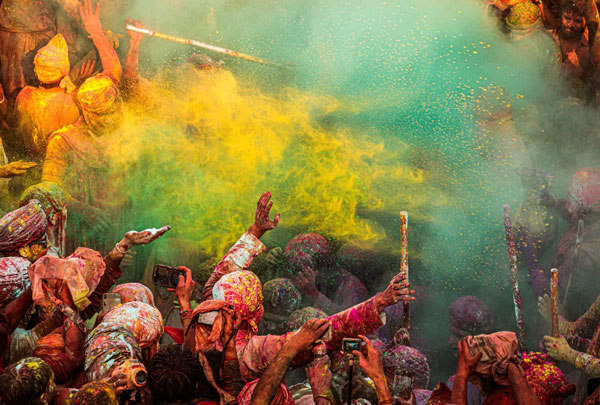
Several days before the main Holi celebrations cover Mathura and Vrindavan in color, the towns of Barsana and Nandgaon become the center of one of the Braj region’s most distinctive traditions. Known as Lathmar Holi, the celebration is connected with stories of Radha and Krishna and follows customs that have been maintained by local communities for generations. The sight of women carrying wooden sticks, men holding shields, clouds of gulal filling narrow streets, devotional songs echoing around temples, and thousands of people gathering in the small towns has made Lathmar Holi internationally recognizable.
For foreign travelers, however, Lathmar Holi in Barsana and Nandgaon requires more understanding and preparation than its colorful photographs might suggest. It is not simply a public event where tourists arrive and watch a short performance from a designated seat. The celebration takes place within pilgrimage towns containing narrow streets, old temples, steep approaches, residential areas, and public spaces that become extremely crowded. Religious traditions, community participation, playful rituals, temple ceremonies, and large-scale color celebrations occur together.
Barsana is traditionally associated with Radha, while Nandgaon is associated with Lord Krishna. This relationship is central to the character of Lathmar Holi. According to popular tradition, Krishna and his companions visited Radha’s village and playfully teased Radha and her friends. The women responded by driving them away with sticks. The modern celebration symbolically recalls this story, with men and women from the two communities taking part in ritualized exchanges.
International visitors who approach Lathmar Holi only as an unusual spectacle may miss much of its meaning. Understanding its connection with Braj culture, Radha-Krishna devotion, temple traditions, music, and local identity turns the visit into a much richer cultural experience.
What Is Lathmar Holi?
The word Lathmar combines words associated with a wooden stick, or lath, and striking. This has led to simplified descriptions of the festival as the “Holi where women beat men with sticks.” Although the sticks are certainly the most visually famous part of the celebration, that description does not adequately explain the tradition.
Lathmar Holi is part of the larger Braj Holi season. The celebration is rooted in local stories surrounding Radha and Krishna and takes place before the principal Holi day. Men traditionally associated with Nandgaon visit Barsana, where women symbolically strike them with sticks while the men protect themselves with shields. A related celebration then takes place in Nandgaon.
The atmosphere includes much more than the lathmar ritual. Colored powder, devotional songs, temple ceremonies, community gatherings, processions, traditional clothing, and large crowds are all part of the occasion. For many participants, the event is connected with religious devotion and local identity rather than being merely a form of entertainment.
Foreign visitors should therefore avoid reducing the festival to the stick ritual. Time spent at the temples, listening to devotional music, observing the preparations, and understanding the relationship between Barsana and Nandgaon provides essential context.
The Story of Radha and Krishna Behind Lathmar Holi
The Braj region is closely associated with stories from the life of Lord Krishna, and many local Holi traditions are connected with the playful relationship between Krishna and Radha. According to the popular story behind Lathmar Holi, Krishna traveled from Nandgaon to Barsana with his companions and playfully teased Radha and her friends. The women responded by chasing the visitors away with sticks.
The annual celebration symbolically recreates this playful encounter. Men representing the Nandgaon side visit Barsana and participate in the traditional ritual with local women. The following celebration in Nandgaon reverses the geographic setting and continues the relationship between the two towns.
For international visitors unfamiliar with Hindu traditions, this background is important. Without it, the use of sticks and shields can appear confusing or aggressive. Within the traditional context, the ritual represents a playful episode associated with Radha and Krishna and forms part of a much larger season of devotional Holi celebrations across Braj.
The Radha-Krishna connection can be seen throughout the region in temples, devotional songs, religious paintings, greetings, and the behavior of pilgrims. A guide who understands Braj traditions can help foreign visitors recognize these references throughout the festival.
Lathmar Holi in Barsana
Barsana, located in Uttar Pradesh’s Braj region, is traditionally regarded as the home of Radha. During Lathmar Holi, this relatively small pilgrimage town receives enormous numbers of visitors. Roads become congested, parking areas are established away from the central streets, and visitors may need to walk considerable distances before reaching the main temple and celebration areas.
The town’s most important religious site is the Shri Radha Rani Temple, also widely known as the Ladli Ji Temple. Positioned on a hill, the temple becomes one of the focal points of the Holi celebrations. Pilgrims climb toward the temple while colored powder fills the surrounding lanes and devotional chants continue around them.
The physical layout of Barsana makes the experience particularly intense. Narrow lanes and steep approaches that feel atmospheric on a normal day can become extremely crowded during Lathmar Holi. Foreign visitors should be prepared for close physical proximity to other people and slow movement through certain areas.
The celebration should not be rushed. Reaching Barsana, walking toward the main areas, observing temple traditions, experiencing the color celebrations, and then leaving through festival traffic can consume much of the day.
Shri Radha Rani Temple During Lathmar Holi
The Radha Rani Temple is central to Barsana’s religious identity and has a special importance during the Holi season. Devotees gather in and around the temple to sing, pray, throw colored powder, and celebrate Radha and Krishna.
For international travelers, the temple provides a much deeper understanding of why Barsana is central to Lathmar Holi. The celebration is not taking place in a random village selected for a tourist event; it is happening in a major center of Radha devotion.
During the festival, access can become extremely crowded. Visitors may encounter tightly packed queues, stairs, colored powder, singing, and significant movement around the temple courtyard. Anyone uncomfortable in dense crowds should discuss the visit carefully with a guide before entering the busiest areas.
Photography rules and access conditions can change according to crowd management and temple requirements. Religious instructions should always take priority over photography.
The Famous Lathmar Tradition in Barsana
The best-known ritual involves women from Barsana symbolically striking participating men with wooden sticks while the men use shields for protection. Crowds gather to watch as the traditional exchange unfolds amid music, color, laughter, and public excitement.
International visitors often arrive expecting the entire town to be filled with random stick fighting. That is not an accurate way to understand the event. The traditional ritual follows a cultural context and involves participants familiar with the custom.
Foreign tourists should not attempt to join the stick ritual without clear local guidance. Being a spectator does not automatically give a visitor permission to participate. Staying in an appropriate viewing area and following instructions from local authorities or an experienced guide is considerably safer.
Crowd movement can change quickly around the main activity. Photographers in particular should resist pushing forward merely to obtain a closer image. A longer lens and a safer position can often produce better results than standing directly beside the action.
Lathmar Holi in Nandgaon
After the celebration in Barsana, the focus shifts to Nandgaon, traditionally associated with Krishna and his foster family. Nandgaon has its own Lathmar Holi traditions and receives visitors from Barsana as part of the continuing symbolic relationship between the two towns.
The setting is different but equally significant. Nand Bhavan, an important temple situated on elevated ground, becomes a major center of activity. The approaches to the temple fill with pilgrims, colored powder, musicians, and Holi participants.
For foreign visitors planning to attend both Barsana and Nandgaon celebrations, it is important to understand that these events take place on different days. They should not be treated as two sightseeing stops that can be covered quickly on the same afternoon.
Attending both gives travelers a more complete picture of Lathmar Holi because they can see how the traditions connect the two communities. It also provides additional opportunities for temple visits, photography, and understanding the wider Braj Holi season.
Nand Bhavan and Holi Celebrations in Nandgaon
Nand Bhavan is traditionally associated with Nanda, Krishna’s foster father, and forms an important religious landmark in Nandgaon. The temple’s elevated location provides views over the surrounding area, but during Holi the visitor’s attention is likely to be focused on the intense activity within and around the temple.
Devotees gather closely together as colored powders are thrown and devotional songs are sung. The atmosphere can become extremely energetic, particularly when large groups arrive at the same time.
International travelers should protect their eyes, cameras, phones, and personal belongings before approaching the busiest sections. The fine powder used during Holi can enter electronic equipment easily, and there may be little opportunity to stop and reorganize belongings once inside a dense crowd.
Visitors should also follow temple etiquette concerning footwear and restricted areas. A religious celebration does not remove the normal expectation of respectful behavior within a sacred place.
Samaj Gayan and the Musical Side of Braj Holi
One of the aspects international travelers may overlook is the importance of devotional music during Braj Holi. Traditional singing associated with Radha and Krishna forms an important part of the festival atmosphere, particularly around temples.
Samaj Gayan refers to a devotional singing tradition in which groups perform compositions associated with the religious heritage of the Braj region. Listening to these songs inside or around historic temples can provide a completely different perspective from the energetic color throwing outside.
Foreign visitors do not need to understand every word to appreciate the role of the music. A guide can explain the broad themes and religious references, allowing travelers to connect what they hear with the traditions they see around them.
Spending some time observing these musical gatherings also provides a welcome change of pace from the busiest outdoor crowds.
When Is Lathmar Holi Celebrated?
Lathmar Holi dates change every year because the festival follows the Hindu lunar calendar and forms part of the broader schedule leading up to Holi. It generally takes place in the weeks or days before the main Holi celebration, usually during February or March.
Barsana and Nandgaon celebrate on different days. International travelers should therefore confirm the specific annual schedule before booking hotels and flights.
This is especially important for overseas visitors planning a trip specifically around Lathmar Holi. Simply searching for the date of the main Holi festival and arriving one day before it may mean missing the Barsana and Nandgaon events entirely.
A properly planned Braj itinerary can include Barsana Lathmar Holi, Nandgaon Lathmar Holi, selected Mathura and Vrindavan celebrations, Holika Dahan, and the main Holi day depending on the traveler’s available time.
How Many Days Should Foreign Travelers Allow?
Visitors whose main purpose is Lathmar Holi should allow several days in the Braj region rather than making a rushed day trip from Delhi. The exact number depends on which celebrations they want to attend.
Barsana and Nandgaon require separate days if both Lathmar events are included. Additional days are needed for Vrindavan, Mathura, temple celebrations, and the main Holi day.
A longer stay also provides some recovery time. Holi days can involve early starts, long walks, heavy crowds, traffic delays, dust, color powder, and many hours outdoors. Scheduling major events on every morning and evening without breaks can become exhausting.
Foreign photographers often benefit from extra days because weather, light, crowd position, and access can affect photography significantly.
What Foreign Tourists Should Expect
Lathmar Holi is considerably more intense than a controlled festival program at a hotel. Visitors should expect colored powder on their face, hair, clothing, and belongings. Even travelers who do not actively throw colors may be covered simply by moving through the crowd.
Physical space becomes limited in the busiest areas. Streets that normally accommodate local traffic may be filled almost entirely with pedestrians. Temple approaches can become tightly packed, and moving only a short distance can take significant time.
Noise levels are also high. Drums, music, chanting, shouting, and public announcements combine with the excitement of the crowd.
Travelers who are uncomfortable with these conditions can still visit the Braj region during the Holi season, but they may prefer less crowded celebrations rather than the central Lathmar events.
Photography at Lathmar Holi
For travel photographers, Lathmar Holi in Barsana is one of North India’s most visually dramatic festivals. Bright clouds of gulal, women carrying sticks, men holding shields, traditional clothing, temple architecture, musicians, pilgrims, and narrow village streets provide a wide range of subjects.
The same conditions that make the festival visually impressive also make it difficult to photograph. Fine powder can damage cameras, and water may be used in some areas. Dense crowds make it difficult to carry large equipment bags or change lenses safely.
Photographers should prepare the camera before entering the main celebration area. A protective camera cover, clear filter where appropriate, secure strap, spare batteries, sufficient memory cards, and a lens suitable for both portraits and medium-distance action can reduce the need to change equipment.
Close portraits should still be taken with permission whenever practical. The fact that someone is participating in a public festival does not remove their right to personal space.
Protecting Cameras and Phones from Holi Colors
Holi powder can enter buttons, lens mechanisms, microphones, charging ports, and other small openings. International travelers carrying expensive equipment should take protection seriously.
Phones can be placed inside waterproof pouches that still allow basic operation. Cameras require more specialized protection because completely sealing them may interfere with controls and ventilation.
Changing lenses in the middle of a color-filled street should be avoided. Carrying one versatile lens may be safer than repeatedly opening the camera body.
Travelers should also avoid cleaning powder from equipment by immediately rubbing it into surfaces. Professional photographers may wish to bring appropriate cleaning equipment and wait until they return to a controlled environment.
What to Wear at Lathmar Holi
Travelers should wear clothing they are prepared to stain permanently. White or light-colored clothes are popular because Holi colors appear clearly in photographs, but practical considerations are more important than appearance.
Fabric should remain opaque when wet. Women may prefer a longer top with trousers, while men can wear lightweight trousers and a comfortable shirt or T-shirt. Very loose clothing can become inconvenient in dense crowds.
Closed or securely fastened footwear is preferable. Flip-flops can be lost easily when streets become crowded.
Sunglasses provide some protection from airborne powder, while a scarf or bandana can protect hair and face. Travelers with contact lenses may find glasses more comfortable because powder can irritate the eyes.
Safety for International Travelers at Lathmar Holi
Safety requires more attention here than at an ordinary sightseeing destination. The main concern for most visitors is not the traditional stick ritual itself but the density and unpredictability of the crowds.
Foreign travelers should stay with their guide or travel companions and establish a meeting point before entering the main area. Mobile signals may be unreliable when large crowds gather, and hearing a phone ring can be difficult.
Passports, expensive jewelry, unnecessary cards, and excess cash should remain securely at the hotel. Carry only essential items in a secure bag that cannot be opened easily from behind.
Visitors should avoid accepting unknown food or drinks from strangers. Bhang or other intoxicating preparations may be consumed during Holi celebrations, and travelers should always know what they are drinking.
Women traveling alone should take particular care in very dense public celebrations and may feel more comfortable with a private guide and trusted transportation arrangements.
Respectful Participation and Local Etiquette
Holi encourages playful interaction, but visitors should not assume that every person wants color applied to them. Asking before approaching someone with gulal remains the respectful choice.
International tourists should not imitate the Lathmar stick ritual randomly in the streets. The tradition has a specific community and cultural context, and careless imitation can be disrespectful as well as unsafe.
Temple rules should be followed carefully. Shoes must be removed where required, and visitors should not enter areas marked as restricted. Photography restrictions may become stricter during religious ceremonies.
Respect is particularly important when photographing elderly pilgrims, children, priests, women participating in rituals, and people engaged in prayer.
Food and Drinking Water During Lathmar Holi
Barsana and Nandgaon are pilgrimage towns, and food options during the festival period can become extremely busy. Vegetarian food is widely available, including snacks, sweets, dairy products, and North Indian dishes.
Foreign travelers should not rely on eating whenever they happen to become hungry in the middle of the crowd. A substantial breakfast before departure and a planned meal after leaving the busiest area can be more comfortable.
Carry safe drinking water and remain hydrated. Festival excitement, walking, sun exposure, and crowded conditions can make travelers forget to drink regularly.
Those with sensitive stomachs should choose freshly cooked food from reliable establishments and be cautious with raw foods or dairy products that have been sitting unrefrigerated for long periods.
How to Reach Barsana and Nandgaon
Barsana and Nandgaon are located within the Braj region of Uttar Pradesh and are normally reached by road. Mathura and Vrindavan serve as practical bases for many visitors, while some travelers arrive from Delhi or Agra.
During Lathmar Holi, normal travel times should not be trusted. Road congestion, police diversions, temporary parking arrangements, pedestrian crowds, and vehicle restrictions can substantially increase journey times.
A private vehicle with a driver familiar with the region is useful, but vehicles may have to stop well before the central celebration areas. Travelers should be prepared to walk from designated parking or drop-off points.
Leaving after the festival can also take time. International visitors should avoid scheduling an evening train, flight, or another tightly timed commitment immediately after attending Lathmar Holi.
Where Should Foreign Travelers Stay?
For most international visitors, staying in Mathura or Vrindavan is more practical than relying on accommodation immediately around Barsana or Nandgaon. These larger pilgrimage centers offer a broader range of hotels and easier connections with other Braj destinations.
Travelers who prioritize higher accommodation standards may need to choose carefully because hotel categories and facilities vary significantly across the region. Room cleanliness, hot water, heating or cooling, vehicle access, breakfast, and distance from major roads should all be checked.
During Holi, good accommodation sells quickly. Booking several months in advance is advisable, particularly for travelers who require a specific standard of hotel.
The location should also be chosen according to the full festival itinerary rather than only the Barsana visit.
Combining Lathmar Holi with Mathura and Vrindavan
A foreign traveler who has already come to the Braj region for Lathmar Holi should normally include Mathura and Vrindavan as well. The three areas are culturally connected, but each offers a different festival experience.
Mathura is associated with Krishna’s birthplace and has major temple and public celebrations. Vrindavan is known for Krishna and Radha temples, devotional Holi traditions, flower celebrations, and large gatherings around important temples. Barsana and Nandgaon add the distinctive Lathmar customs.
Together, they allow travelers to understand Holi as a series of religious and community traditions rather than a single day of throwing colored powder.
Enough nights should be included so that visitors are not moving hotels constantly between celebrations.
Combining Lathmar Holi with Delhi, Agra and Jaipur
The Braj region sits naturally within a Golden Triangle itinerary. International visitors can travel from Delhi to Mathura and Vrindavan, attend the selected Holi celebrations, continue to Agra for the Taj Mahal, and then travel onward to Jaipur.
A practical route can be:
Delhi – Mathura – Vrindavan – Barsana – Nandgaon – Agra – Jaipur
The exact sequence should be adjusted according to the confirmed festival dates. Because Barsana and Nandgaon events take place on fixed days, the rest of the itinerary should be built around them rather than attempting to move the festival dates around an existing tour.
Travelers with additional time can continue from Jaipur into Rajasthan, visiting Pushkar, Jodhpur, Udaipur, or Jaisalmer.
Planning a Lathmar Holi Tour with India Fortune Journey
A Lathmar Holi tour for international travelers needs considerably more planning than a normal Mathura or Vrindavan sightseeing trip. The annual dates must be checked carefully, Barsana and Nandgaon celebrations need to be distinguished, accommodation should be reserved early, and transportation has to account for road restrictions and heavy crowds.
India Fortune Journey can arrange a private itinerary covering Delhi, Mathura, Vrindavan, Barsana, Nandgaon, Agra, Jaipur, and other North India destinations according to the traveler’s available days. Private transportation, suitable accommodation, local guiding, sightseeing, and festival visits can be organized around the confirmed Braj Holi calendar.
For photographers, the itinerary can allow more time around important celebrations rather than attempting to cover several distant destinations on the same day. For first-time visitors, additional cultural explanation and a slower schedule can make the experience more manageable.
The strongest Lathmar Holi journey is one that goes beyond the famous photographs of sticks and colored powder. Seeing Radha Rani Temple in Barsana, visiting Nand Bhavan in Nandgaon, hearing devotional music, understanding the Radha-Krishna stories, observing local communities, and then continuing through Mathura and Vrindavan gives international travelers a much more complete understanding of Holi in the Braj region.
Fair Festivals
Personalized Travel Experiences Across India
Tell us about your
Travel Plans
Share your travel preferences and our destination specialists will create a personalized itinerary along with the best travel recommendations and pricing. Most inquiries receive a detailed response within 24 hours with no obligation.
Have a Question?
Whether you're planning a private tour, luxury holiday, family vacation, chauffeur-driven journey, hotel booking, or a customized India itinerary, our travel experts are ready to assist you.
Share your requirements and we'll provide the best travel options, recommendations, and pricing tailored to your needs.